





Selecting the Best HSC Subjects for Your Future University Plans
HSC Mathematics | HSC Exams | HSC English
Confused by HSC subjects and Year 10 program selection? Discover how to balance prerequisites, scaling, and student interest to maximise ATAR results with JDN Tuition’s expert guide for NSW parents.
Watching your child finish Year 10 feels like a massive milestone. It marks the end of general schooling and the beginning of the “business end” of high school. Suddenly, the choices made today feel like they carry the weight of the entire future and can easily be the most stressful time for families.
Simultaneously, you are likely hearing conflicting advise from everywhere. One school parent swears that HSC science is necessary for a high ATAR, while another insists that dropping Mathematics is the key to survival. The fear of closing doors too early or picking the “wrong” HSC subjects is real, but it doesn’t have to be paralysing.
In this blog, we cut through the noise. By the end of this blog, you’ll know how to choose the right HSC subjects for your child’s university goals and everything that goes into it. Want more blogs on HSC subjects? Check out our JDN Tuition Blog Page for more.
The Non-Negotiables of Subject Selection
Before selecting your Year 10 subjects, there are a few things you and your child should know.
Prerequisites vs. Assumed Knowledge
When talking about your child’s passions and interests, we must address the rigid framework of university admissions. The most critical distinction to make during HSC subjects selection is between a “prerequisite” and “assumed knowledge.” A prerequisite is a hard rule. If a university course lists a specific curriculum as a prerequisite, and your child hasn’t completed that course according to the HSC syllabus, they will not be offered a place, regardless of their final ATAR. It is a locked door. For instance, many specific Engineering degrees require Advanced Mathematics; without it, direct entry is denied. That’s why, when going over your list of HSC subjects, you should be aware of what university courses your child may be locked out of.
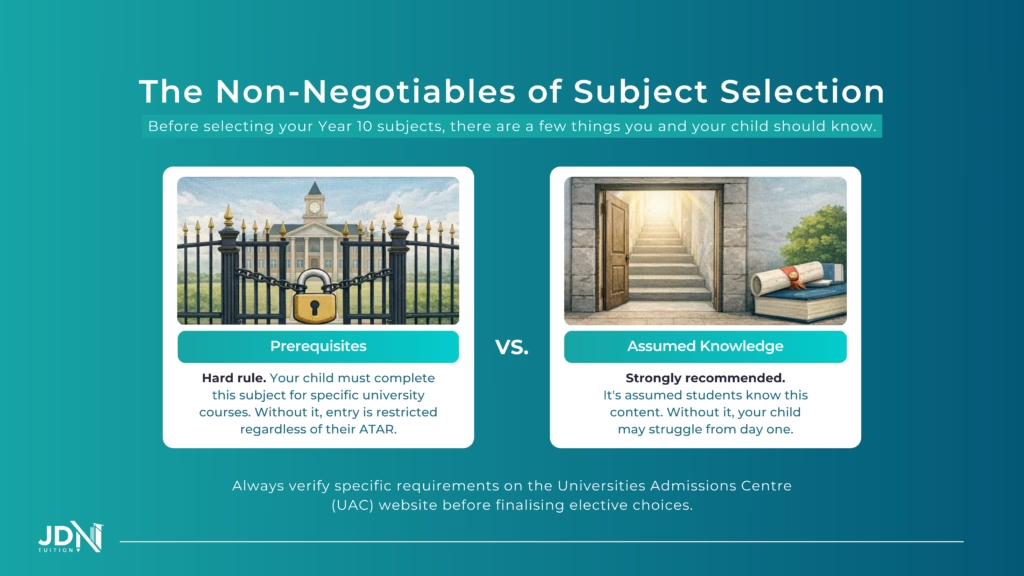
“Assumed knowledge” is softer, but dangerous to ignore. It means the university lecturers will deliver the first-year content assuming every student in the hall has completed specific HSC subjects. While your child can technically enter the degree without this knowledge, they will start at a significant disadvantage. They may need to complete costly and time-consuming bridging courses over the summer or in their first semester just to catch up. Always verify these specific requirements directly on the Universities Admissions Centre (UAC) website before finalising elective choices.
Mandatory English
There is one universal non-negotiable that applies to every single student in NSW: English. NESA regulations state that two units of English must count towards the final ATAR calculation. This means that no matter how much a student might dislike the subject, their performance in English will directly impact their final rank. It is almost always the first exam listed on the HSC exam timetable, setting the tone for the whole period. Therefore, the choice isn’t if they do English, but which level. Deciding between English Standard and the more demanding HSC English Advanced, or even English Extension 1 and 2, is a pivotal decision that hinges on their current literacy skills and their ability to analyse complex texts under the pressure of year 12 exams.
The Truth About Scaling: Why You Shouldn’t “Game” the ATAR
Perhaps the most pervasive and damaging myth in the High School Certificate landscape is the idea that certain subjects are “golden tickets” to a high ATAR. You might hear whispers in the school car park that “you have to take Physics to get a 90” or that “Standard Maths will ruin your ranking.”
This leads many parents to push their children into high-level subjects they have no interest in, purely for the mathematical advantage. The reality is that scaling is designed to facilitate fairness, not to be a cheat code. It exists to compare results across different courses, ensuring students taking highly rigorous subjects aren’t disadvantaged. However, it doesn’t automatically give points to students just for partisipating.
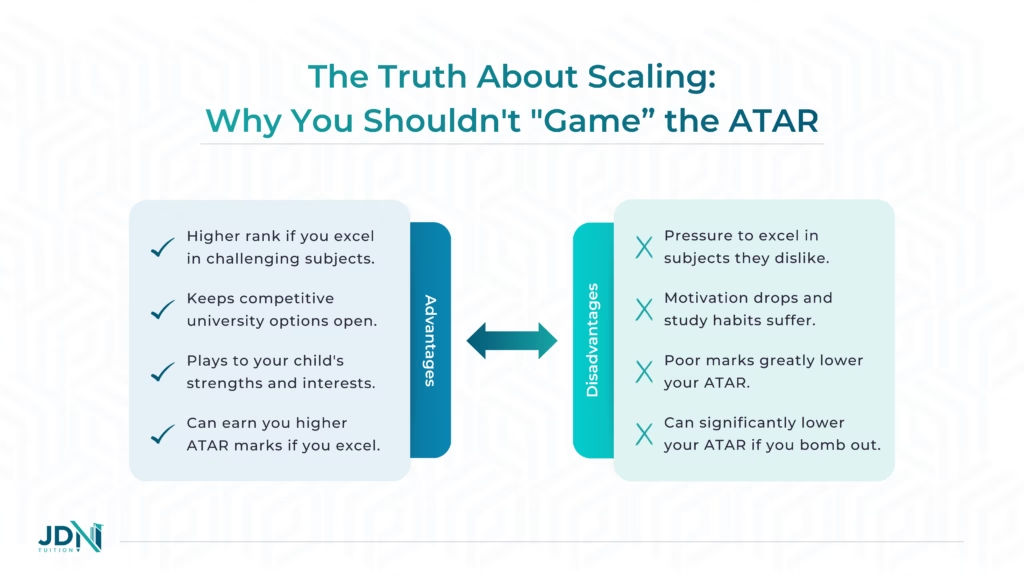
Scaling works by assessing the strength of the cohort rather than the difficulty of the content itself. However, the mechanism is often misunderstood. The “Danger Zone” is when a student selects a high-scaling course like Chemistry and other Science subjects in the HSC, but performs poorly. A low band in a “high scaling” subject contributes significantly less to an ATAR than a Band 6 in a so-called “low scaling” subject like visual arts or modern history. If a student hates the content, their motivation drops, their study schedule falls apart, and their HSC marks suffer. You cannot rely on scaling to saave a bad raw mark.
Why Does High Performance Matter More?
Consider a student aiming for a competitive health science degree. They might feel pressured to take all the hard sciences. However, if they struggle with the abstract concepts in Physics, that poor result will drag their aggregate down. Conversely, if they are passionate about History, they are more likely to achieve high marks in Ancient History. Genuine engagement often leads to stronger results. These marks can scale better than a mediocre result in a subject they dislike.
Ultimately, the best strategy is not to game the system but to play to your child’s strengths. Success comes from consistent effort and a structured approach, such as maintaining a solid study timetable throughout the senior years. This discipline often starts young; students who engage with primary school tutors are more likely to build foundational habits that often transition more smoothly into the demands of Year 11 and 12. However, even if those habits aren’t perfect yet, it is not too late to build them.
Is your child struggling to navigate the scaling minefield? Whether you need flexible tutoring services for high school students to boost confidence in a tricky elective or comprehensive HSC tutoring to map out a strategy for Year 12, JDN Tuition is here to help. Check out our Google Business Profile today to discuss how we can support your child’s academic journey.
Workload Management: The Hidden Killer of ATARs
While capability and interest are vital, practical logistics can quietly undermine a strong ATAR needed for your child’s university goals. We often see ambitious students take on multiple “Major Work” subjects, such as Visual Arts, Design & Technology, Drama, or English Extension 2. While these courses offer a fantastic creative outlet, they carry a massive hidden cost: time. A Major Work is a year-long commitment that requires hundreds of hours of documentation, refinement, and execution. Many students often forget just how demanding it can be.

The danger arises when students choose multiple Major Work subjects simultaneously. The “crunch time” for these projects, usually late Term 2 and Term 3, almost always overlaps with the Trial HSC exams. If a student is juggling three different portfolios, they often find they have zero hours left to study for their written exams. This is where a high-quality hsc tutor becomes invaluable. They don’t just teach content; they teach problem-solving strategies for time management, ensuring students don’t burn out right before the finish line.
Why is Finding Balance Key?
To survive Year 12, balance is key. If your child loves creative subjects, balance them with exam-based subjects to spread the load. Efficiency in study becomes non-negotiable. Techniques like active recall, where you test yourself rather than passively reading notes, are essential for retaining information quickly. Furthermore, engaging in active learning during sessions prevents the “zoning out” that happens in large classrooms. For example, professional maths tutoring can turn a subject that usually takes hours of frustrated struggle into a streamlined, understandable process, freeing up precious time for those demanding Major Works.
Struggling to help your child balance their workload? At JDN Tuition, we help students work smarter, not just harder. From optimising study schedules to mastering difficult concepts efficiently, our expert HSC tutors are here to support your child’s balance. Take a look at our reviews to see why Australia’s parents choose JDN Tuition for their HSC needs.
The Strategic 12 Units: Year 11 as a Trial Run
Starting Year 11 with 12 or even 14 units is one of the smartest strategic moves a student can make. While only the best 10 units contribute to the final ATAR calculation, taking an extra subject acts as valuable academic insurance. It enables your child to approach the Preliminary year as a low-risk “trial run,” exploring a wider range of disciplines before the stakes rise in Year 12.
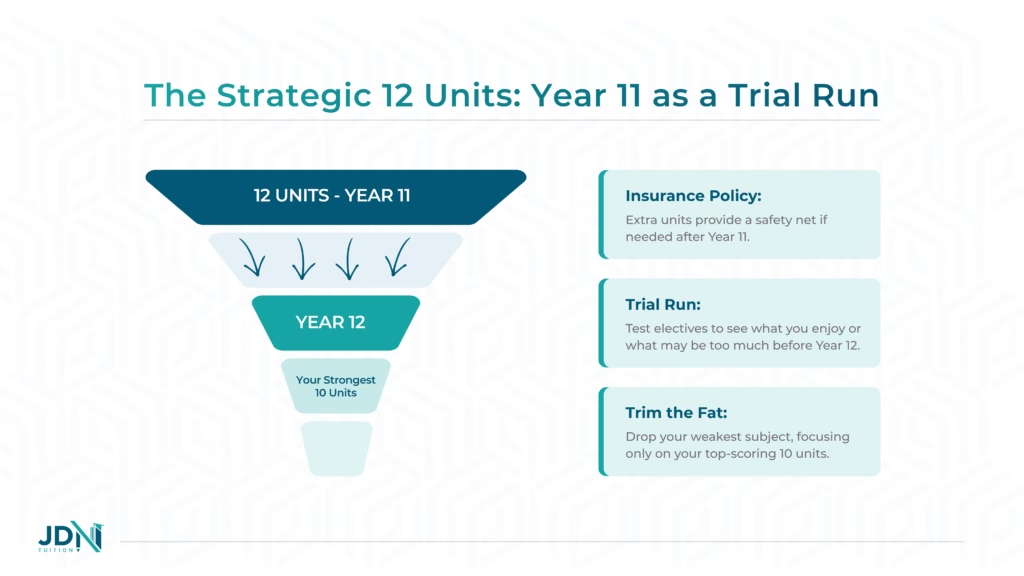
The beauty of the 12-unit load is the flexibility it provides at the end of Year 11. If a student discovers they despise a particular elective or struggle significantly with the content, they can simply drop that subject. This “trims the fat,” leaving them with their strongest 10 units for the final HSC sprint.
Additionally, this gives your child a preview of what the subject may be like at university. It also provides the flexibility to drop the subject if it doesn’t suit them.
During this trial period, students should actively engage with HSC Past Papers and review the HSC exam papers marking guidelines to see if the assessment style suits them. They might find that while they enjoy the classroom discussion in Modern History, the rigorous essay writing requirements under exam conditions are too stressful.
Using a comprehensive HSC study planner during this time helps reveal which courses consume the most energy for the least return. The only exception to this strategy is English; since 2 units of English must count towards the ATAR, it cannot be dropped from the calculation, only improved. For everything else, the 12-unit start gives your child the power of choice.
Backwards Mapping: A Step-by-Step Exercise for Parents and Students
Instead of staring blankly at the subject selection booklet, feeling overwhelmed, try a strategy called “backwards mapping.” This is a practical, actionable exercise that you and your Year 10 child can do tonight at the kitchen table. It flips the entire process on its head: instead of asking “What subjects do I like now?”, you ask “Where do I want to be in three years?” and work backward from that destination. It turns an emotional, daunting decision into a logical checklist.
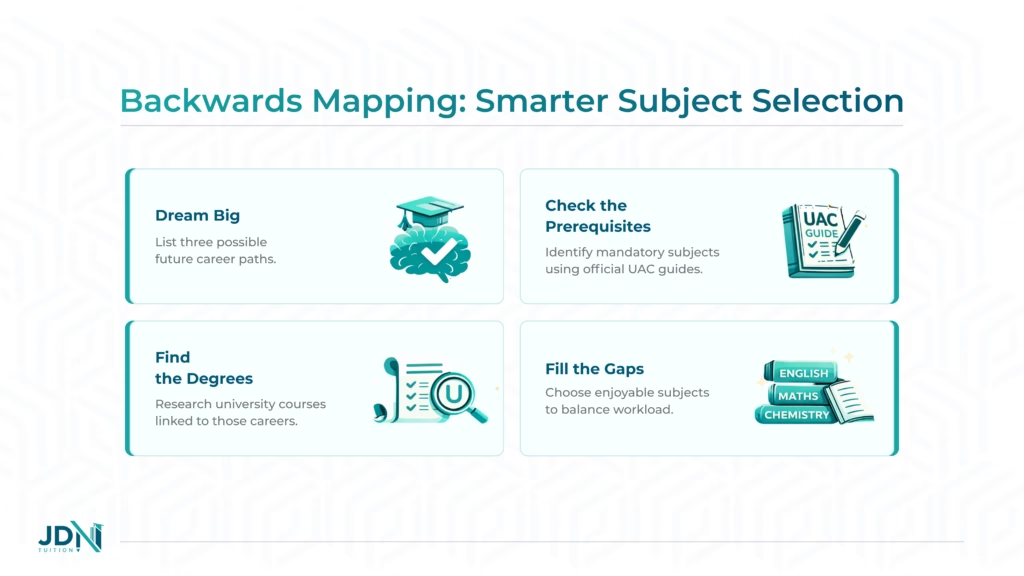
Here is the step-by-step plan:
- Dream Big: Have your child list three potential career paths (e.g., Architect, Physiotherapist, Financial Analyst).
- Find the Degrees: Look up which university degrees lead to those careers on university websites.
- Check the Rules: Use the UAC guide to identify the strict prerequisites for those specific degrees. Write these down; they are your non-negotiables.
- Fill the Gaps: With the mandatory subjects locked in, fill the remaining units with subjects they genuinely enjoy or excel at to balance their load.
Don’t panic if your child has absolutely no idea what they want to do. That is perfectly normal for a 16-year-old. In that scenario, your strategy is to keep the widest variety of “golden doors” open. This usually means choosing the highest level of Mathematics and English they can handle comfortably. It should be combined with a balanced mix of science and humanities subjects. This approach helps prevent them from limiting their future options too early.
Conclusion: Choosing the right HSC subjects
Choosing the right HSC subjects is ultimately about finding the sweet spot between university requirements and your child’s genuine passions. Ignore the scaling rumours, lock in those prerequisites, and prioritise subjects where your child will feel motivated to learn. Remember, the HSC is a marathon, not a sprint, and there are always alternative pathways to success if plans change.
You don’t have to make these big decisions alone. At JDN Tuition, our expert high school tutors are ready to guide you through the maze of HSC tuition. Whether you need strategic advice or targeted one-on-one tutoring to build confidence for the years ahead, we are here to help. Contact us today to book an academic assessment and start Year 11 on the front foot.
Improve Results. Start Today.
📞 Book a FREE Call: (02) 7257 0299
📧 Email us: contact@jdntuition.com.au
What subjects do 99.95 ATAR students do?
Does scaling matter?
Yes, but less than you think. Scaling exists to level the playing field. It does not reward students for choosing hard subjects. A high rank in a lower-scaling subject, such as Business Studies, will almost always outperform a low rank in a higher-scaling subject, such as Physics.
What is the most dropped subject in High School?
Mathematics Advanced is one of the most frequently dropped subjects. Many students move to Mathematics Standard after finding the calculus workload too demanding. Other subjects with high drop rates include Software Design and Development and Economics. Students often underestimate the depth of theory in these subjects during Year 10.