



How to Create Powerful ChatGPT Prompts for Learning and Revision?
Writing Prompts | AI prompts | Essay Writing
AI in education has become increasingly prevalent, and strong ChatGPT prompts are now essential for students seeking optimal results from AI tools. Unfortunately, answers often come back long, vague, and not quite right because the prompt itself lacks clarity. Consequently, this means students need to know how to write the best prompts to maximise their education. Unfortunately, answers often come back long, vague and not quite right.
This is one of the most common problems students run into when using AI for school. The tool itself isn’t exactly broken, just the prompt.
ChatGPT for students can be genuinely powerful when used the right way. It can support essay planning, exam revision, and understanding tricky concepts. But it only ever works as well as the instruction it receives.
This guide is for parents who want to help their child get real results from AI. We’ll break down the strategies behind the best ChatGPT prompts for students. You’ll learn exactly how to write stronger ChatGPT prompts from the ground up. Want more tips on how to maximise AI tools for education? Take a look at the JDN Tuition blog page.
What is ChatGPT and How Does it Actually Work?
ChatGPT is an artificial intelligence chatbot developed by OpenAI. It generates text responses based on whatever input it receives. That input is called a prompt.
The AI itself is called generative artificial intelligence. This means it predicts and builds a response word by word, based on patterns it learned during training. Unlike a search on Google, the response is different every single time.
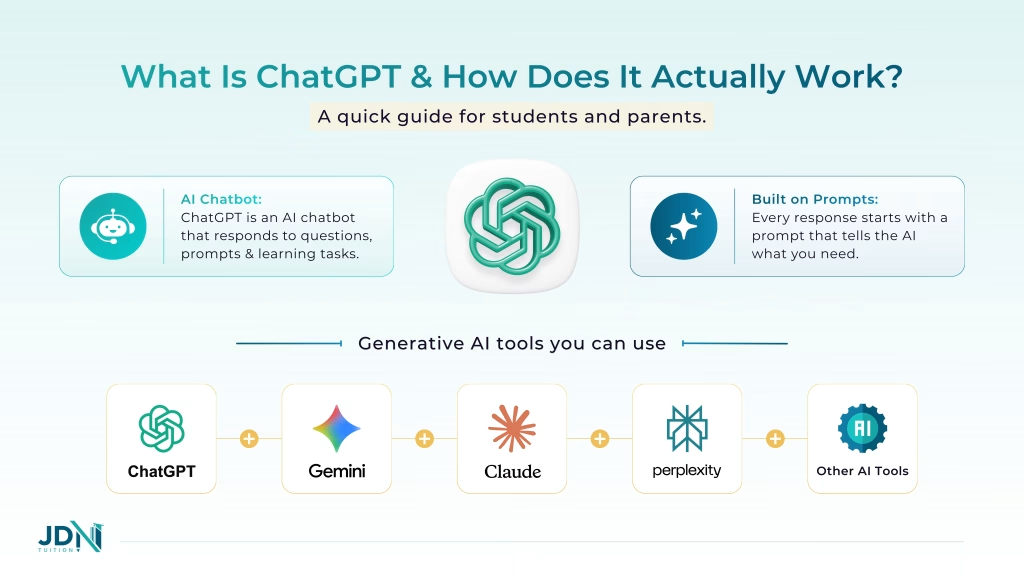
Think of it as a virtual assistant trained on an enormous amount of text. It can summarise, explain, write, and brainstorm across almost any topic. There are numerous AI systems to choose from, including ChatGPT 4.0 (and its newer versions), Google Gemini, Claude, Perplexity, and many other options.
To use these effectively, a student needs to craft a prompt that maximises their learning.
Why Most Students Use ChatGPT the Wrong Way?
Most students open ChatGPT and type something like “explain photosynthesis” or “write me an essay on World War 2.” Then they wonder why the answer feels generic. Vague input produces vague output. Students who haven’t learnt how to use ChatGPT effectively consequently use it as they’ve known how to for their whole life. Like a search engine. They type short questions and accept the first answer they receive.
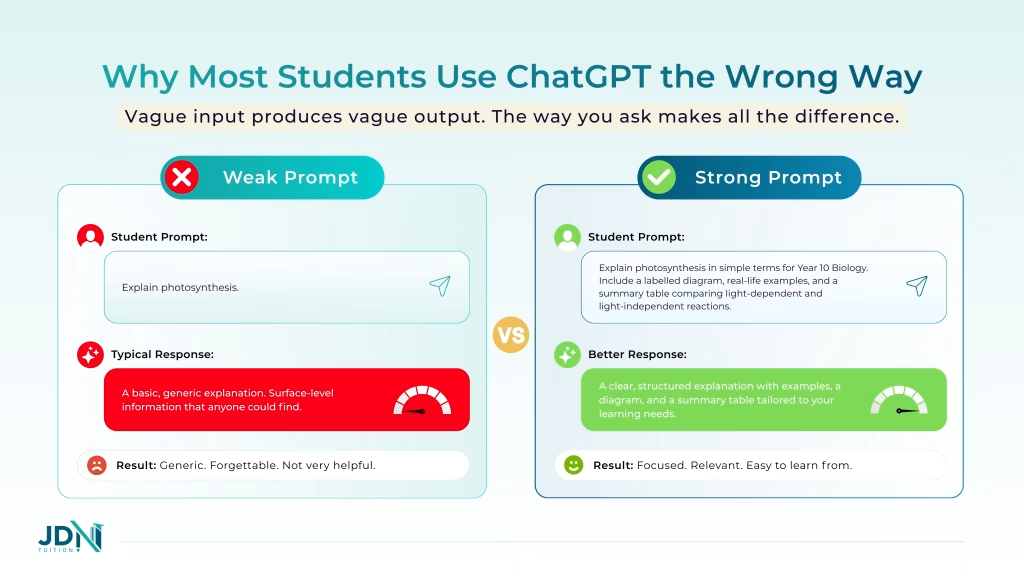
AI assisted learning works differently. It works best when your child brings context, direction, and a clear goal to every conversation. ChatGPT rewards effort, not passivity. Used well, it becomes a genuine AI companion for study. It can challenge your child’s thinking, break down complex ideas, and help them prepare for assessments.
The Four Building Blocks of a Great ChatGPT Prompt
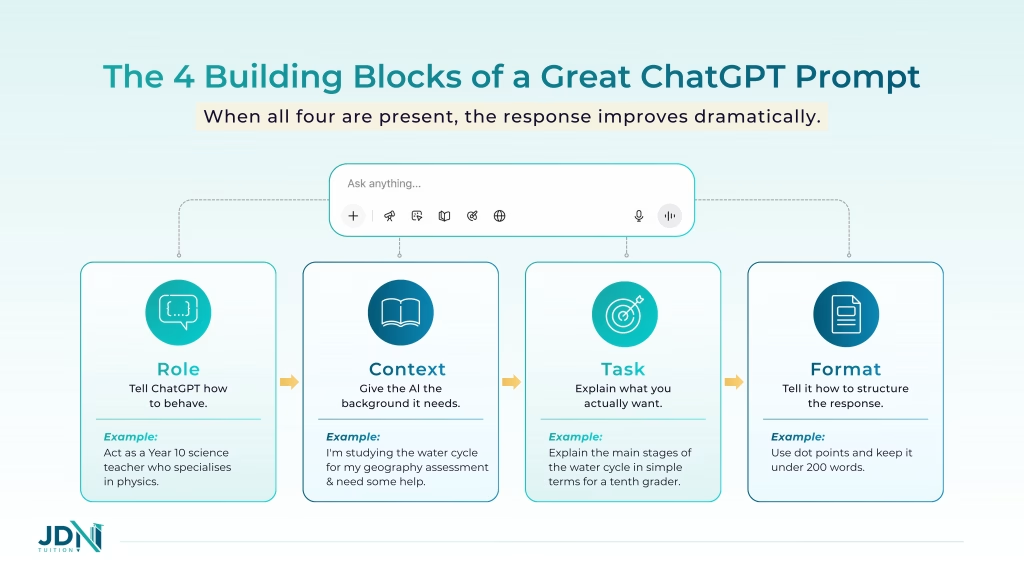
There are a few simple tips on how to use ChatGPT for maximum effect, but it does require your child to think before they type. The best prompts for ChatGPT share four key ingredients: role, context, task, and format. When all four are present, the response improves dramatically.
-
Role: Tell ChatGPT how to behave. For example: Act as a Year 10 science teacher who specialises in physics.
-
Context: Give the AI the background it needs. For example: I’m studying the water cycle for my geography assessment and need some help.
-
Task: Explain what your child actually wants. For example: Explain the main stages of the water cycle in simple terms for a tenth grader.
-
Format: Tell it how to structure the response. For example: Use dot points and keep it under 200 words.
Put it all together, and you have a prompt like this:
You are an expert mathematics tutor who explains everything in clear detail at the 8th-grade level. I need to know all about trigonometry before my exam. Break down the basics of Sin, Cos, and Tan with dot points for each. Additionally, create a mnemonic so I can memorise the whole thing.
Together, those four elements form one of the most effective AI prompts a student can use for revision. The response becomes specific, targeted, and easy to build on.
This is the foundation of strong ChatGPT prompting strategies so that your child can begin controlling the conversation.
Additionally, if your child doesn’t want to go through the whole process of creating their own prompt, you can use a ChatGPT prompt generator or other AI prompt generators to get started. These can be helpful when your child is unsure where to begin. But once they understand the four elements above, they won’t need to rely on them for long.
Another easy method is to ask the AI itself to create the prompt for you. Simply outline what you want it to do and let it do the work for you.
At the end of the day, knowing how to write the best AI prompts is a skill that pays off across every subject. It sharpens essays, improves revision, and makes every study session more productive.
ChatGPT Prompts for Essay Writing
Essay writing is one of the areas where ChatGPT delivers the most value when used correctly. The keyword is correct.
Your child should never paste a question into ChatGPT and submit whatever comes back. That’s not how they’re going to make the level of complexity required for academic writing that schools often expect. It’s also not learning.
ChatGPT also works well as the best AI for writing feedback tool. Your child pastes in their draft paragraph and asks: “What’s weak about this argument? How can I strengthen it?”
Used this way, it acts as an AI-powered research assistant that can genuinely help your child.
Ready to take your child’s essay writing further? The expert team at JDN Tuition offers personalised High School Tutoring that builds the real academic skills AI simply can’t teach.
ChatGPT Prompts for Exam Revision
Exam preparation is where ChatGPT genuinely shines. It’s available any time of day, endlessly patient, and happy to ask your child the same question twenty times without complaint.
How to study for exams has changed. Students no longer need to rely solely on textbooks and past papers. They can use ChatGPT to generate practice questions, test their recall, and identify gaps in their knowledge.
Here are some study tips and methods your child can apply immediately using ChatGPT:
- Ask it to generate ten short-answer questions on a specific topic. Then answer them without looking at notes. Paste the answers back and ask ChatGPT to assess them against the key concepts.
- Ask it to quiz your child in a specific format. For example: “Ask me five multiple-choice questions on the causes of World War 1, one at a time. Wait for my answer before moving on.”
- Ask it to explain a concept three different ways if the first explanation doesn’t land.
Using ChatGPT to Build Study Notes and Schedules
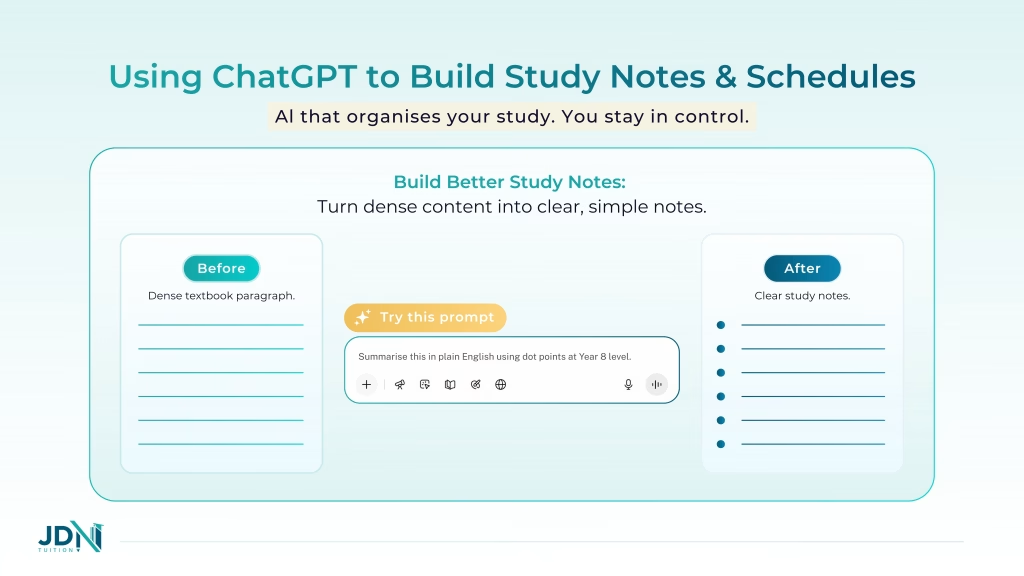
Study notes are only as useful as the understanding behind them. ChatGPT helps your child turn dense textbook content into something clear and manageable.
Encourage your child to paste a difficult paragraph from their class notes and prompt: “Summarise this in plain English using dot points at Year 8 level.” It’s one of the most practical how to take notes that AI makes possible.
ChatGPT also makes creating a study schedule simple. Your child lists upcoming assessment dates, available study hours, and subjects. ChatGPT then builds a personalised weekly plan around those commitments.
Used consistently, it becomes a reliable AI study companion that keeps your child organised without thinking about them. Other best AI study tools worth exploring include Notion AI and Google NotebookLM.
Across every year level, the best AI tools for students work best as a support system. They improve how your child studies. They make every session more focused and productive.
Want structured expert support alongside these tools? JDN Tuition offers trusted Primary School Tutoring that builds strong foundations early. Check our Google Business Profile and read our reviews to see the results for yourself.
What Parents Should Know About AI in Australian Schools?
AI in education is growing rapidly across Australia. Many parents feel uncertain about what this means for their child’s schooling and assessment.
Generative AI in schools is no longer rare. Generative AI tools, including ChatGPT prompts, are now commonly used by students both inside and outside the classroom. The conversation is no longer about whether AI belongs; it’s about how it can be effectively utilised. It’s about how to use it responsibly.
The Australian Curriculum doesn’t prohibit AI use. It does expect students to demonstrate critical thinking and produce original work. Schools across the country are currently navigating that balance.
AI tools for education, like ChatGPT and Gemini, are widely used by students and teachers alike. NSWEduChat is a government-approved platform built specifically for NSW students and staff. It provides a safer, curriculum-aligned AI experience for younger learners.
AI learning tools for students deliver the best results when paired with strong foundational skills. AI tutors can explain and summarise, but they can’t build genuine understanding through consistent practise.
The use of AI in education will keep evolving. Staying informed and talking openly with your child is one of the most important things you can do as a parent.
How to Avoid Plagiarism When Using AI?
How to avoid plagiarism is one of the most important conversations parents can have with their child right now. AI makes copying easier, but it also makes detection easier.
Most Australian schools now use detection tools that flag AI-generated content. Students who submit AI-written work as their own face serious academic consequences. More importantly, bypassing assessment means your child misses the learning entirely. That gap tends to show up later.
Encourage these three habits: Use AI to understand concepts, not to produce work. Rewrite any AI-generated content entirely in your own words. Cite AI assistance whenever school policy requires it.
The last one is probably the most important. If you’re in any doubt at all, talk to your child’s teacher about their AI policy, especially if it’s not explicitly stated on something like an assessment notification. The worst feeling for a student is finishing a project only to find out that it’s invalid due to one misstep.
Conclusion: ChatGPT Prompts in Summary
At the end of the day, writing the best ChatGPT prompts is about giving AI the tools it needs to succeed. That is, its role, the context, the task, and how to deliver it. With these four ingredients, any student can turn an AI into a workhorse for fulfilling their education needs.
In the modern age, the use of AI is becoming more common in smart learning, so equipping your child with the knowledge to use it is very important. Unfortunately, however, AI isn’t always enough to complete your child’s education.
Sometimes, they need targeted support that goes beyond what an AI can handle. This is where JDN Tuition steps in, with personalised private one-on-one tutoring to take your child above and beyond. In addition to regular tutoring, we set your child up with the tools needed to succeed, including how to wrangle AI to best benefit them. If you want to help your child get ahead in the AI space and in the classroom, contact us today. You can get in touch with us through our website’s contact page to get started. Don’t let this opportunity slip away. Talk to us today about your child’s future.
Boost Confidence. Improve Results. Start Today.
 Book a FREE Call: +61 2 7202 1930
 Email us: contact@jdntuition.com.au
How do I write perfect ChatGPT prompts?
The easiest way is to use an AI prompt generator or even ask your chosen AI to make one for you. If you want complete control, however, define the AI's role, context, task, and format in each message.
What is the best use of AI?
AI can be used for essay writing, planning, exam preparation, and almost anything you can imagine. To make the best use of it, optimise your prompts so you don't grow frustrated from constantly rewriting messages.
What are the common mistakes of AI?
Artificial intelligence is prone to something called AI hallucinations, being made up information that is wrongful, off-topic or otherwise disingenuous. You should always double-check information from AI.