






Choosing the Best VCE Subjects to Reach Your ATAR Goal
ATAR Calculator | VCE exams | VCE Psychology
Discover how to strategically select VCE subjects and maximise your child’s ATAR potential by avoiding common scaling traps with this comprehensive guide.
It is often the most stressful time of year when the kitchen table turns into a negotiation zone. You are likely staring at a confusing list of VCE subjects, wondering if choosing Physics over Biology affects an engineering dream. The pressure feels intense. Every choice seems like a high-stakes gamble, where one wrong move could cost valuable points.
Many families assume a high ATAR comes from choosing the hardest VCE courses that supposedly scale up. The reality is more nuanced. It is about finding the perfect intersection between specific ability, genuine interest, and university prerequisites long before the VCE exam timetable is even released. This guide cuts through the noise of scaling myths and peer pressure to help you build a strategic academic roadmap. While the final VCE exams might seem far away, the decisions made now lay the foundation for success. For more expert insights on navigating these crucial years, take a look at the JDN Tuition Blog Page for more.
Decoding the ATAR: How the Numbers Actually Work
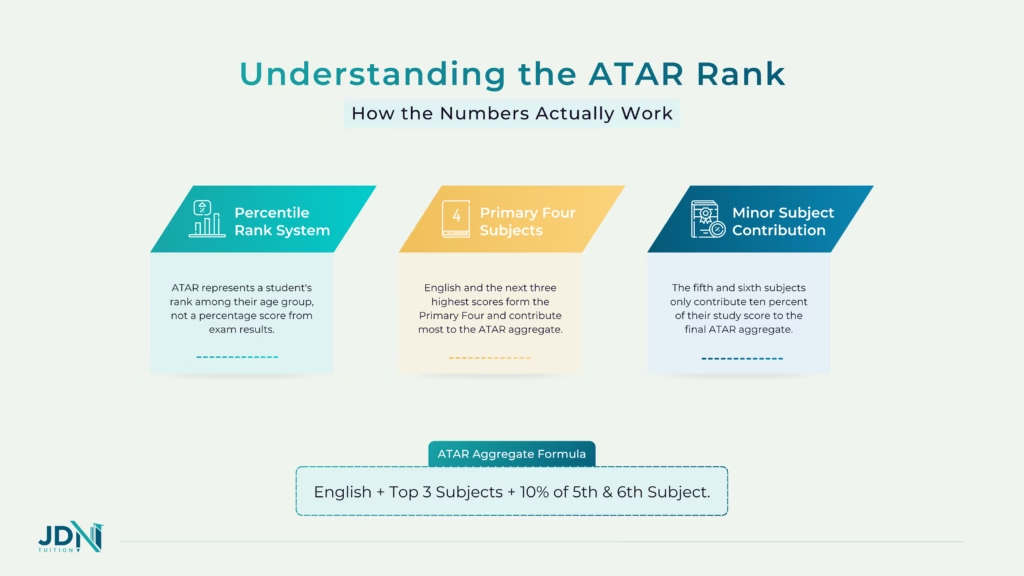
The most common misconception parents hold is viewing the ATAR score as a percentage mark, similar to a score on a maths test. It is essential to understand that ATAR stands for Australian Tertiary Admission Rank. It represents a percentile position, comparing a student against their entire age cohort. A rank of 75.00 does not mean the student achieved 75% on their exams; it means they performed better than 75% of the population. Understanding this distinction changes how families should approach the final two years of schooling.
The Importance of the Primary Four
The final rank is calculated from an aggregate total, and the formula used by the Victorian Tertiary Admissions Centre is quite specific. The aggregate consists of the VCE English subject score plus the scores of the next three highest-scoring subjects. These are known as the “Primary Four,” and they make up the vast majority of the total points. Any fifth or sixth subjects students complete count as increments and contribute only 10% of their final score to the aggregate.
This mathematical reality has profound implications for a student’s VCE study schedule. Many students exhaust themselves trying to achieve perfection across six subjects, unaware that the difference between a study score of 30 and 40 in a fifth subject only adds a single point to their aggregate. By using a VCE study score calculator, families can simulate different scenarios and often realise that strategically focusing energy on the Primary Four yields better results than spreading efforts too thin. It allows the student to play to their specific learning style, prioritising depth in their strongest areas rather than struggling for marginal gains in their weakest.
Don’t let your child fall behind in their primary four. JDN Tuition provides personalised online tutoring to help students maximise their study scores in those critical Primary Four subjects. Visit the JDN Tuition Google Business Profile to see how our high school tutoring can help your child reach their ATAR goals.
The Non-Negotiables (University Prerequisites)
The most critical error families make isn’t choosing a subject that scales down, but choosing subjects that lead to a dead end. This brings us to the golden rule of VCE subject selection: specific course eligibility always trumps your overall rank. A student might achieve a fantastic ATAR, but if their dream degree requires VCE Chemistry and they dropped it in Year 11, they cannot receive an offer. Prerequisites are the non-negotiables that must anchor every decision you make during this process, serving as the foundation upon which the rest of the academic structure is built.
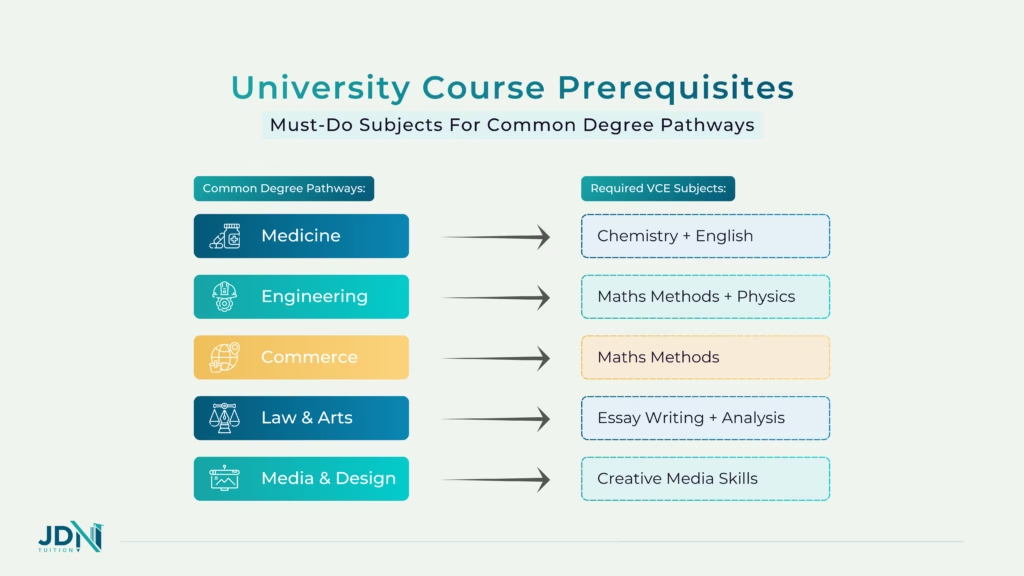
University requirements follow predictable patterns, but they can be strict. For instance, Commerce degrees frequently mandate Maths Methods, while Medicine usually requires Chemistry alongside a high study score in English. While arts and law degrees may have fewer specific prerequisites, they heavily reward the advanced essay writing and analytical capabilities built in the humanities. Similarly, media or design courses often look for evidence of creative storytelling and visual communication. Therefore, your strategy should focus on long-term skill development aligned with these future demands.
The Scaling Trap (Myth vs. Reality)
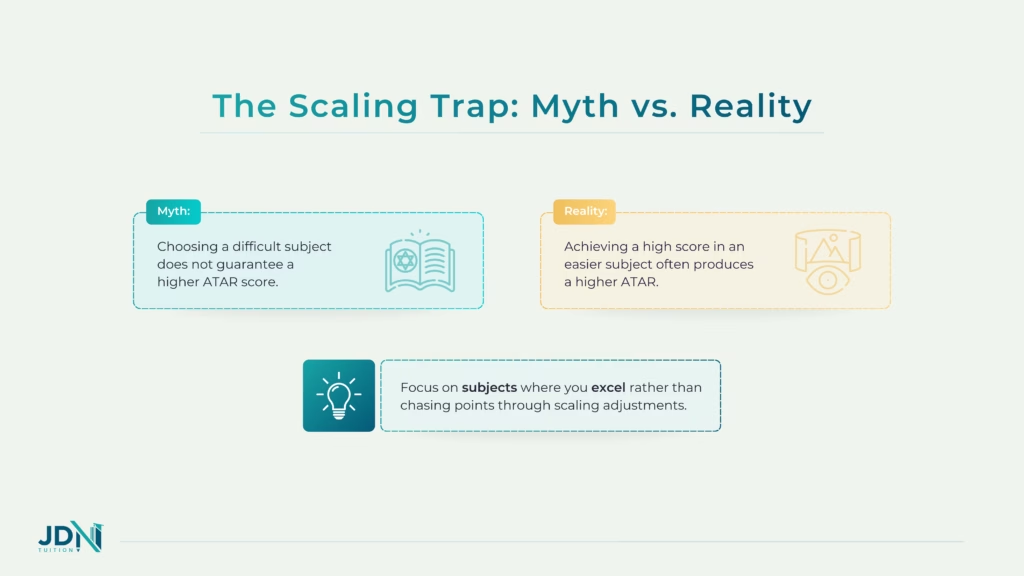
The most common high school myth is that choosing “hard” subjects guarantees a high ATAR. Parents often insist their child take Specialist Maths or Latin solely because they “scale up” by ten or twelve points. While some subjects adjust upwards for cohort competitiveness, relying on this without considering student capability is risky. This obsession with VCE Scaling often obscures the fact that scaling is designed to create a level playing field, not to reward students simply for showing up to a difficult class.
The Risks of Focusing on Scaling
When you force a student into a subject they find overwhelmingly difficult, you introduce a significant risk to their academic performance. Let’s consider the complex VCE chemistry study design as an example. It is a rigorous course requiring deep conceptual understanding. If a student has no interest in science and struggles with core concepts, they will likely get a low raw score. Even with significant scaling, a 20 in a “hard” subject usually contributes less to the ATAR than a 40 in a “standard” subject like Psychology or Business Management. Furthermore, the immense time required to pass a difficult VCE mathematics subject barely often cannibalises the study time available for their other subjects, dragging down their performance across the board.
The Engagement Factor
The secret to a high study score isn’t just intelligence; it’s engagement. Effective VCE exam preparation requires a student to be self-motivated. They need to be willing to do the extra work when nobody is watching. If a student enjoys a subject, they are far more likely to proactively complete extra practice essays and sit through timed VCE past papers to refine their skills. Conversely, if they resent the subject, they will do the bare minimum. It is statistically safer to bank on a high raw score in a subject your child loves than to gamble on a scaling boost in a subject they dread.
Is your child struggling to balance difficulty with interest? A dedicated VCE tutor can help them navigate difficult content and boost confidence. Visit JDN Tuition to see how we have helped hundreds of students achieve their best, and check reviews to see why parents trust our strategic approach.
Building a Strategic Subject Combination
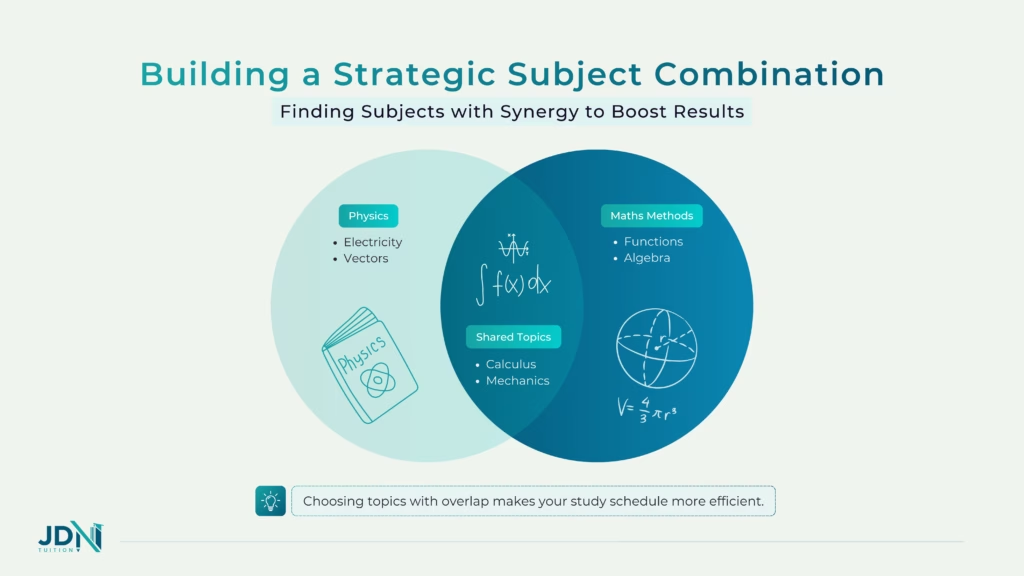
Thinking about subjects in isolation is a tactical error. A smarter approach involves viewing the VCE as a cohesive workload where subjects can complement one another. This concept is often called ‘subject synergy’. When a student selects courses that share similar skills or content knowledge, they effectively reduce their overall study load. Concepts learned in one classroom reinforce what teachers teach in another, creating a compounding effect on understanding and retention.
The Power of Subject Synergy
Creating a ‘portfolio’ of complementary subjects is a highly effective strategy for high achievers. For a student inclined towards STEM, pairing Physics with VCE maths subjects like Mathematical Methods or Specialist Mathematics is a classic move. The calculus used in Methods is directly applicable to the mechanics found in Physics. This means the student practises the same skills across two subjects. It increases exposure without doubling the effort. Similarly, VCE biology pairs exceptionally well with Chemistry or Psychology. Understanding the chemical basis of life helps students grasp biological processes more easily. General Mathematics also supports the statistical analysis required in Psychology.
The same principle applies to the humanities. Subjects like Legal Studies, Global Politics, and History all rely heavily on the same core competencies: researching evidence, structuring complex arguments, and refining analytical skills. Improvement in writing a history essay will almost certainly lead to better performance in Legal Studies. Instead of switching between unrelated tasks like French, Accounting, and Physics, the student can stay in a consistent thinking zone. This leads to deeper mastery and often higher study scores across the board.
Choosing an English Subject
An English subject must count in the top four for ATAR calculation, so choosing the right “flavour” of English is crucial in Year 11. This decision can significantly impact a student’s overall ATAR outcome. Most students default to mainstream English, but this is not always the best fit. Students who are passionate about reading and enjoy deconstructing classic texts might find VCE literature to be a more engaging and rewarding option. It rewards deep, close reading and original interpretation.
On the other hand, students who are more analytical and perhaps enjoy the logical structure of science or law often thrive in VCE English Language. This subject focuses on linguistics, sociolinguistics, and the mechanics of how language is used in society. It is less about storytelling and more about analysis. Choosing the right English stream for a student’s strengths can turn a requirement into a strong asset for their aggregate score.
Backup Plans and Pathways (Approx. 200 words)
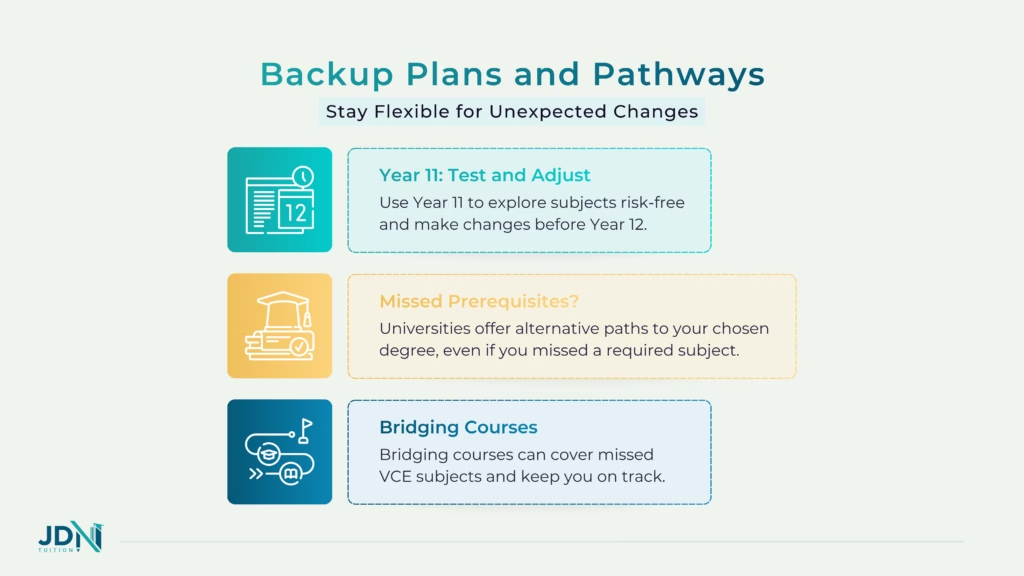
Even the best-laid plans can encounter turbulence. It is not uncommon for a student to begin Year 11 with a firm conviction to study Physics, only to realise by the end of Unit 2 that it does not align with their strengths. Parents should remember that Year 11 serves as a vital testing ground. This flexibility allows students to audit their choices before the high-stakes Unit 3 and 4 sequences commence. If a subject causes excessive stress or the student cannot engage in elaborative rehearsal, it may be time to reconsider. A lack of interest often prevents them from linking new concepts to prior knowledge. In such cases, switching to a more suitable subject can improve both performance and confidence.
Furthermore, missing a prerequisite is not the end of the university dream. While direct entry is the most efficient path, the tertiary landscape is filled with alternative routes. Universities offer bridging courses for students who dropped a required maths or science subject but still want a specific degree. This may add time to their studies, but it ensures that one decision made at sixteen does not permanently close doors. Recognising when a subject isn’t working and adjusting the plan prevents burnout and protects the student’s overall time management, ensuring they can focus their energy where it counts most for their aggregate.
Conclusion
Ultimately, the ATAR is a gateway rather than a destination. By anchoring choices in prerequisites and balancing difficulty with interest, parents can help students build a sustainable path to success. Whether the student is navigating the complex Year 12 legal studies syllabus or mastering chemistry, the right strategy is paramount.
If this roadmap feels overwhelming, JDN Tuition offers expert academic consulting and online VCE tutoring to help students maximise their potential. The experienced VCE tutors at the company are ready to guide families through these crucial decisions. Contact us today to start the conversation.
Improve Results. Start Today.
📞 Book a FREE Call: (02) 7257 0299
📧 Email us: [email protected]
There is no single magic list. The best subjects are those where a student can achieve high raw scores using their strengths and interests. Languages and Specialist Maths may scale up significantly. However, a high score in an enjoyable subject often contributes more than a mediocre score in a hard subject.
It’s generally recommended to complete five subjects in Year 12 to provide a safety net for your ATAR. Only your top four subjects count fully. A fifth acts as a backup if one exam goes wrong. Taking only four leaves, there is no margin for error.
Specialist Mathematics, Physics, Chemistry, and languages like Latin or Chinese Second Language are academically the most rigorous. They have complex concepts and competitive cohorts. However, difficulty is subjective. A student with a mathematical mind may find these easier than writing a complex essay for Literature or History. What are the best subjects for VCE for high ATAR?
Should I do 4 or 5 subjects in Year 12?
What are the Hardest VCE Subjects?