






How the Active Recall Method Boosts Year 12 Study Success?
Effective Study Methods | NSW HSC Syllabus | Learning Technique
Ever crammed the last night before an exam, re-reading your notes over and over again, only to freeze once the actual test begins? That’s the trap of passive study. Real results come from active learning strategies such as practise testing, which powers the science behind active recall. Unlike rote revision, this approach strengthens memory storage. It also makes it much more likely that you’ll recall facts, formulas, and essay ideas when it matters most.
For Year 12 students who have received their HSC exam timetable or VCE exam timetable, this matters more than ever: these are high-stakes external assessments designed to test not just whether you’ve seen the content, but whether you can use it under time limits and unfamiliar prompts. Building regular retrieval practise into your study — not just cramming — mirrors exam conditions. It also closes the gap between “I know this” and “I can apply this” on the exam paper.
In this JDN Tuition blog, you’ll find ways to turn active recall into a study routine that fits your schedule. From flashcards, practise essays, to using HSC exams past papers and making short focus sessions count, these methods are supported by decades of cognitive science and long-time high school tutoring use, designed to improve performance.
What is Active Recall?
So, what is active recall? Put simply, active recall means pulling facts from your memory instead of passively re-reading notes or slides using active learning strategies such as practise testing. The goal of this is to apply the content you know using your brain power and learn more by actually doing. This effortful retrieval strengthens your long term memory and makes it easier to access the same information later under pressure (like in a trial exam or the HSC/VCE).
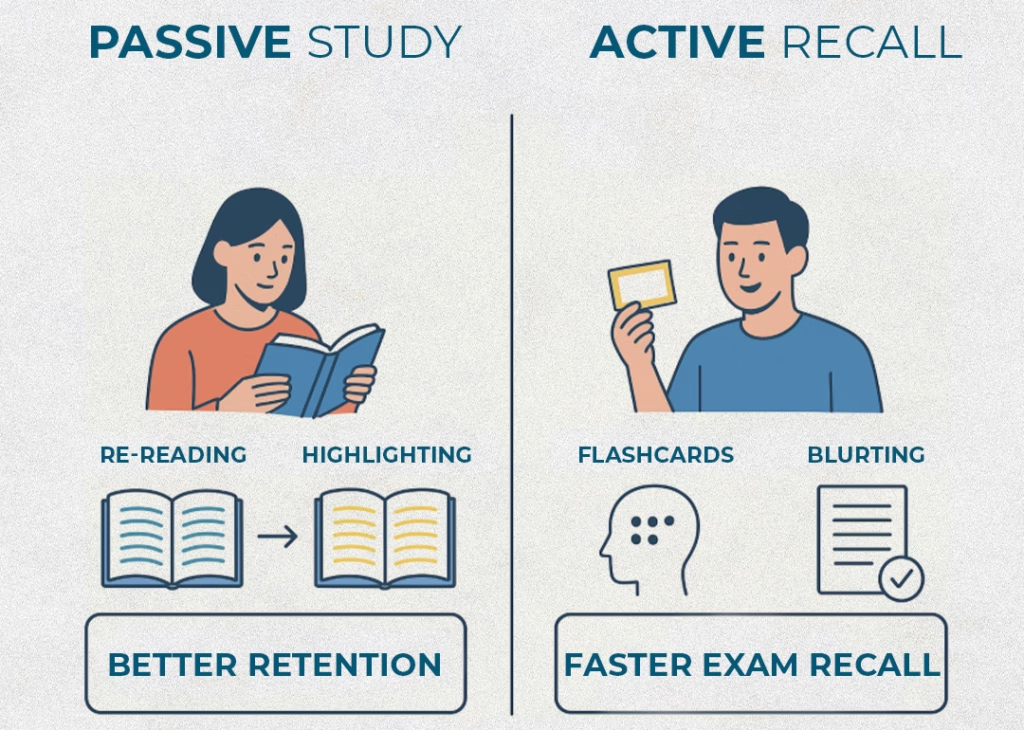
Often, the difference between students who score in the mid-band and those who achieve 95+ ATAR with JDN Tuition’s Year 11 and 12 tutoring comes down to how our expert tutors implement active recall in all of our lessons.
How Active Recall Improves Learning
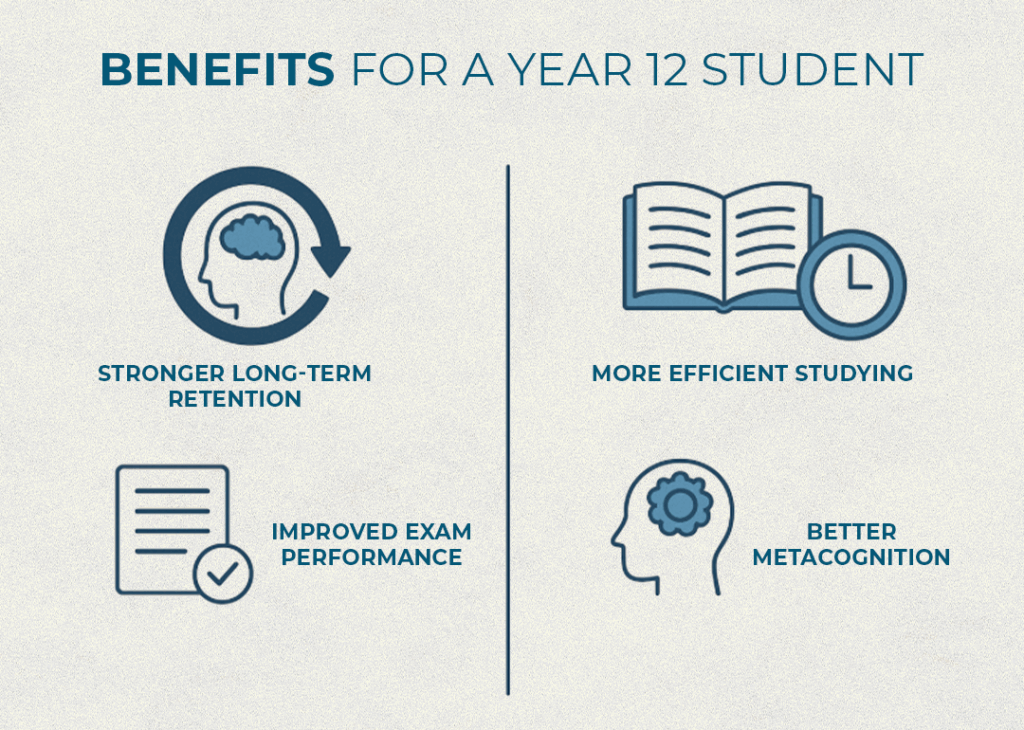
There are many benefits of Active Recall. Active recall is the study habit that makes your brain do the heavy lifting. By forcing retrieval, you strengthen memory traces and make facts stick for the long haul. Over weeks and months, you forget less and spend fewer frantic nights relearning material. It’s also brutally efficient. Regular practise testing exposes gaps in your knowledge. This lets you focus on what you genuinely do not know, rather than re-reading familiar material. Practising recall under timed conditions leads to quicker, more confident answers in the exam room. The more you simulate real-world pressure, the less it can stop you in your tracks.
Why Year 12 Students Should Use Active Recall
In year 12, examiners expect you to apply knowledge, not just repeat it. Timed assessments and unfamiliar questions demand that you retrieve and use information under pressure, and active recall trains exactly that. Year 12 timetables are often extremely busy. Focused retrieval sessions give a far better return on time than passive re-reading. When paired with targeted resources, active recall quickly highlights weak spots so your child can study smarter, not harder. JDN Tuition’s Year 11 and 12 tutoring can strengthen this approach: tutors provide subject-specific resources, run timed practise questions that mirror exam conditions, and can tailor spaced repetition to your child’s workload.
What is Retrieval Practice?
Retrieval practice is a part of a family of techniques that includes active recall. It emphasises intentionally pulling information out of your head (retrieving) rather than pushing it in via more study. Using active revision techniques provides a solid cornerstone for evidence-based learning, working for both classrooms and individual study, as it helps you strengthen your memory and reveals gaps to fix.
To make the most of retrieval practice, top students often introduce a “desirable difficulty.” They purposefully add challenging or application questions to increase effort. At the same time, they avoid tasks so difficult that they always fail. Delayed feedback is another tactic. Commonly known as guess-and-check, this method has you first recall as much as you know. Then, you check what was expected.
Finally, using a variety of contexts helps your knowledge become flexible rather than cue-dependent. Utilising past papers that consist of a mix of different formats, such as multiple choice, short answer, and extended response, helps you work efficiently no matter the problem.
How to Use Spaced Repetition with Active Recall
Spaced repetition is the simple idea of revisiting material just as you’re beginning to forget it, and by pairing that schedule with the active recall method, it turns short-term memory into durable knowledge. For Year 12 students, this means you don’t cram everything the night before a trial. Instead, you plan short, effortful recall sessions over days and weeks. This helps concepts move from fragile to reliable memory. The research supports this: cramming fails. Spaced repetition combined with retrieval practice reliably improves long-term retention. It also shows a clear, demonstrable effect in the classroom.
How to Use Blurting with Spaced Repetition
Blurting is a quick brain-dump technique where you write everything you can remember about a topic in a few minutes, and it is a perfect entry point for a beginner in spaced repetition.
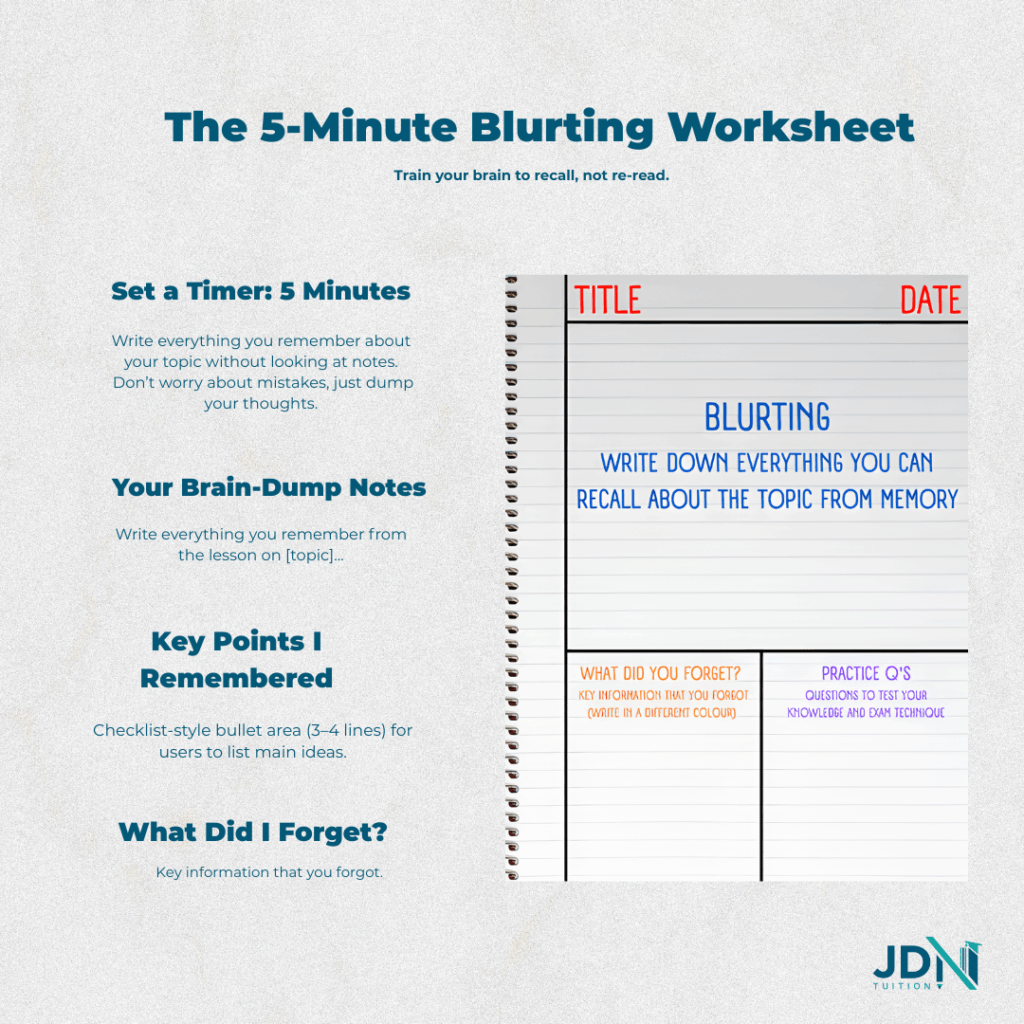
Start a new topic with a blurting session to identify major knowledge gaps. Then schedule short recall checks, such as blurts or flashcard reviews, at increasing intervals. For example, test once on the day you learn it, again after 2–3 days, then a week later, then two weeks, and so on. That expanding interval is a practical starter rhythm many students use. The exact spacing can be adjusted based on how often you forget a card or concept. Research on expanding and fixed spacing schedules shows that both outperform massed practise. Choose a rhythm you can sustain throughout the school term, and that won’t cause burnout during your HSC study sessions.
Finally, think of the blurting session as diagnostic rather than decorative. The goal is to force effortful retrieval (which strengthens memory) and to create a short list of items to target with flashcards or past-paper prompts. When you schedule your spaced reviews, prioritise the items the blurting session shows you missed. That targeted approach is where spacing + retrieval gives the best return on limited Year 12 study time while still hitting all of your required learning objectives.
Year 12 Study Techniques that work with Active Recall
Now that you know the benefits, you might be wondering how to apply active recall to your HSC subjects, or how to make a study plan that won’t hurt your student wellbeing. Below are three simple ways to get you started with active recall.
1. Flashcards: Building Focus Questions
Flashcards are the classic active-recall tool for a reason: they force you to produce an answer from memory rather than recognise it on a page. Making good flashcards means creating tiny, testable prompts. These can include a single formula to reproduce, a quotation with a one-line analysis, a diagram to label, or a worked-step question with the final answer hidden. When you make cards this way and review them on a spaced schedule, you’re combining two of the most powerful memory tools: retrieval practice and spaced repetition, which research consistently ranks as high-utility for improving long term memory retention.
Flashcards help hundreds of students every day, especially top students enduring never-ending exams. Flashcards turn short study bursts into lasting memory. This is especially important for students preparing for their higher school certificates with limited time. An easy flashcard tip is to prioritise quality over quantity. A deck of 100 focused, one-idea cards that you actually review each day easily beats a deck of 1,000 cards you’ll never finish.
2. Mind Mapping and Concept Maps
Mind mapping and concept mapping are often lumped together, but both serve a useful active-recall purpose when used correctly: they expose the structure of a topic so you can test your ability to reconstruct it. A useful study workflow is to study a module, then open a blank page and recreate the mind map from memory (a kind of visual blurting). This forces you to retrieve the relationships between ideas in qualitative analysis, which is especially valuable in subjects that require big-picture thinking, like English, History, Biology, or Economics.
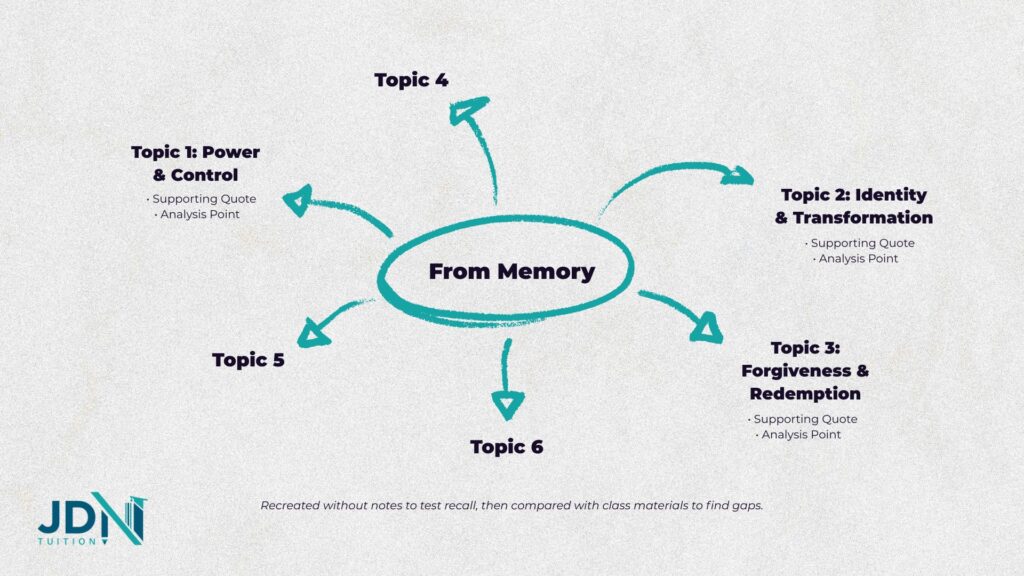
To make mapping truly active, use a two-step loop. First, reconstruct the map cold. Second, compare it to your source material and turn the gaps into short recall tasks, such as flashcards, short-answer prompts, or timed explainers. This converts a static visual into a dynamic retrieval system that tests how well you can reassemble the topic under exam-like pressure. Concept maps also work well before essay writing. If you can redraw your argument map and recall three supporting examples from memory, you’ll write essays faster. You’ll also provide stronger evidence in an unseen exam.
3. The Feynman Technique
The Feynman technique is one of many effective study methods that provide practical ways to achieve active recall.
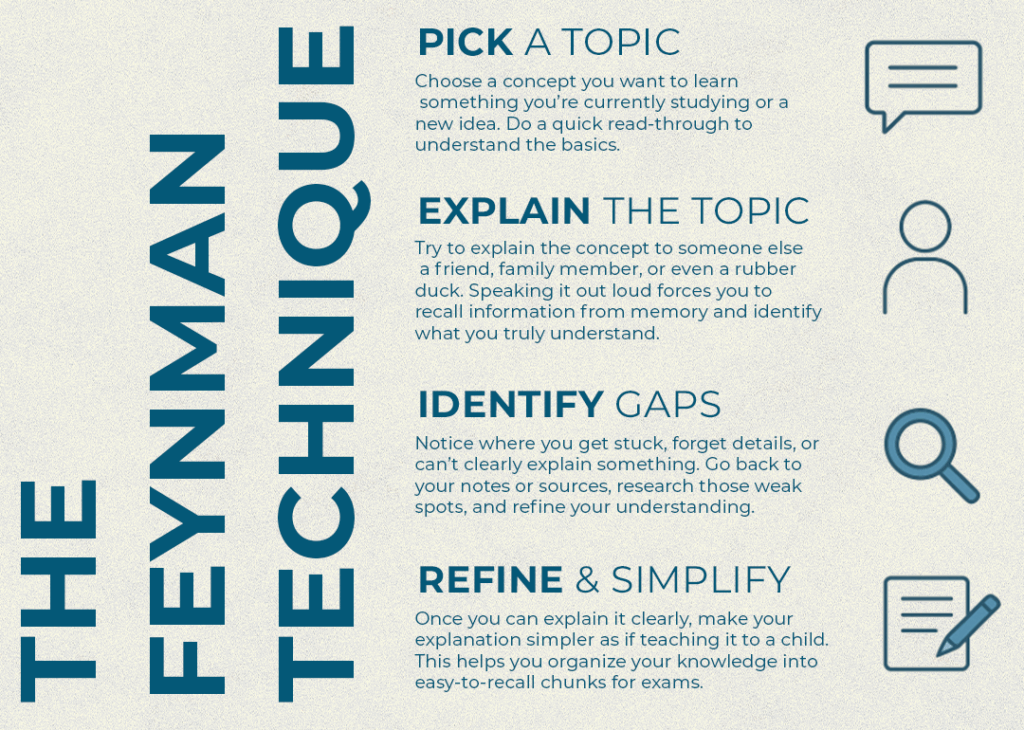
This technique has four easy steps:
- Pick a topic to learn: This can be whatever you’re currently working on, or something new entirely. Then, quickly read up on the topic.
- Explain the topic to a friend: Use active recall by actually applying your knowledge by attempting to explain your subject to a friend, family member, or even a rubber duck.
- See where you can improve: Recognise where you tripped up during your explanation. Did you forget a key point? Did you need to go into further depth at a certain point? If so, conduct more research and repeat step two until you feel comfortable with the issue.
- Refine and simplify your knowledge: Once satisfied with your explanations, work on simplifying them so that even a child could understand. That way, when you need it most in an exam, information can come to you in easy-to-unpack chunks.
How Private Tutoring Helps Students Use Active Recall
Private tutoring turns active recall from a study idea into a daily habit. It does this by personalising what, when, and how you practise retrieval. If you’re looking for targeted support, such as HSC tutoring in Sydney or Melbourne, a tutor can fit around sport and other commitments. They can design short, high-impact recall tasks — including blurting prompts, exam-style mini-quizzes, and micro-flashcard sets — that match your pace. That kind of one-on-one tutoring makes it easier to focus only on the gaps your blurting sessions reveal, rather than wasting time re-reading things you already know.
This is where JDN Tuition comes in, providing subject specialists who use active recall as the backbone of lesson plans: not just explaining content but also helping students produce it by converting your weaknesses into a manageable set of retrieval tasks. With local high school tutors in Melbourne, Sydney, and online tutoring across Australia, we help you achieve your maximum potential. Book now with JDN Tuition and begin your path to success.
Additionally, private tutoring helps students build exam habits. Regular, tutor-led active-recall cycles increase confidence, sharpen timing, and reduce last-minute panic. Spaced repetition works alongside you as your skills grow. Pairing a consistent tutor check-in with your child’s daily blurting and spaced flashcard reviews ensures that exam performance no longer feels like luck. Instead, it becomes a result of deliberate practice.
Don’t let your child waste hours of study time on learning that won’t stick. JDN Tuition tutors train students to use active recall correctly. This ensures that when exams arrive, they have the confidence to succeed. Check out our reviews to see why Australia’s parents choose JDN Tuition. To make sure your child excels, contact us today and make the best of their academic journey.
Call us now: (02) 7257 0299
Or reach out: [email protected]
What is the Difference Between Active Recall and Spaced Repetition?
Active recall is any technique where you actively pull information from memory, such as self-testing, blurting, or teaching-back, rather than passively re-reading. Spaced repetition is the timing system that determines when you revisit that information. It helps you practise recall just as your memory starts to fade. Put simply, active recall is what you do, and spaced repetition is when you do it. Using them together is far more effective than either approach alone.
How Long Should an Active Recall Session Last?
There isn’t a single “magic” length that works for every student or subject. However, practical evidence and student experience suggest two useful rules of thumb. For focused recall work, 25–40 minute blocks with a short break work well for maintaining concentration and preventing burnout. For practising application under exam conditions, you should include longer sessions (60–90 minutes) to build stamina and timing.
Can Active Recall Replace Past Papers?
No, but it complements them. Active recall builds the raw memory and conceptual fluency you need. Past papers train exam application — including timing, translating syllabus knowledge into the exam rubric, and handling novel question wording. Using them together helps students get ahead.