



How is Artificial Intelligence in Education Transforming Learning Experiences
What is AI | Advantages of AI | AI tools
The artificial intelligence (AI) is already rewriting how teachers teach –in fact, it is transforming nearly every aspect of our lives. As the digital landscape continues to evolve, the importance of artificial intelligence in education is becoming more obvious. It is revolutionising the way teachers teach and students learn. The importance of AI in education cannot be overstated. AI has proven itself to be an impactful ally in today’s classrooms. From personalised learning to automated grading systems, AI is redefining the educational landscape. With AI tools, teachers can tailor the learning experience to every individual’s needs, transforming education into a more personalised and engaging experience.
This blog will explore the role of AI in education, examining its benefits and challenges for both students and educators, as well as its impact on communities worldwide.
Understanding AI in Education
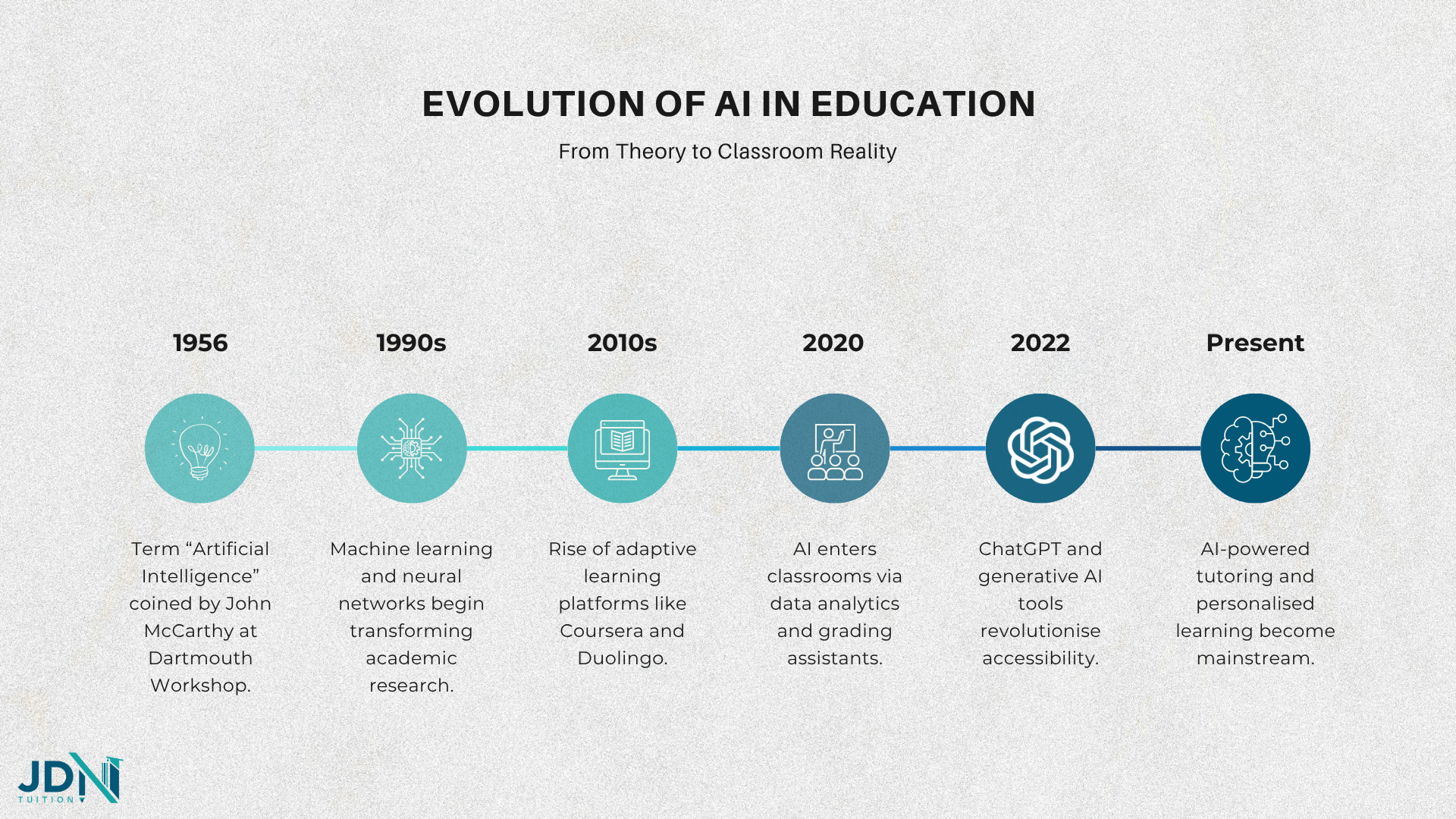
What is AI? Before diving deeper, let’s simplify what AI is, AI history, and what it means in education. The term ‘artificial intelligence’ was basically coined in 1956. In 1956, a college professor named John McCarthy conducted a pivotal workshop, where they coined the term “artificial intelligence”. They aimed to build machines that are capable of reasoning and understanding natural human language. Afterwards, this research interest in AI caught a resurgence in the 1990s with advancements in machine learning and neural networks.
In 2022, the launch of ChatGPT marked an important milestone, showcasing significant capabilities in natural language and fueling further advancements in AI.
At its core, AI in education refers to computer systems that can copy or mimic human intelligence to perform various tasks. These AI-driven tasks include;
- Analysing large volumes of data, such as students’ grading and performance records.
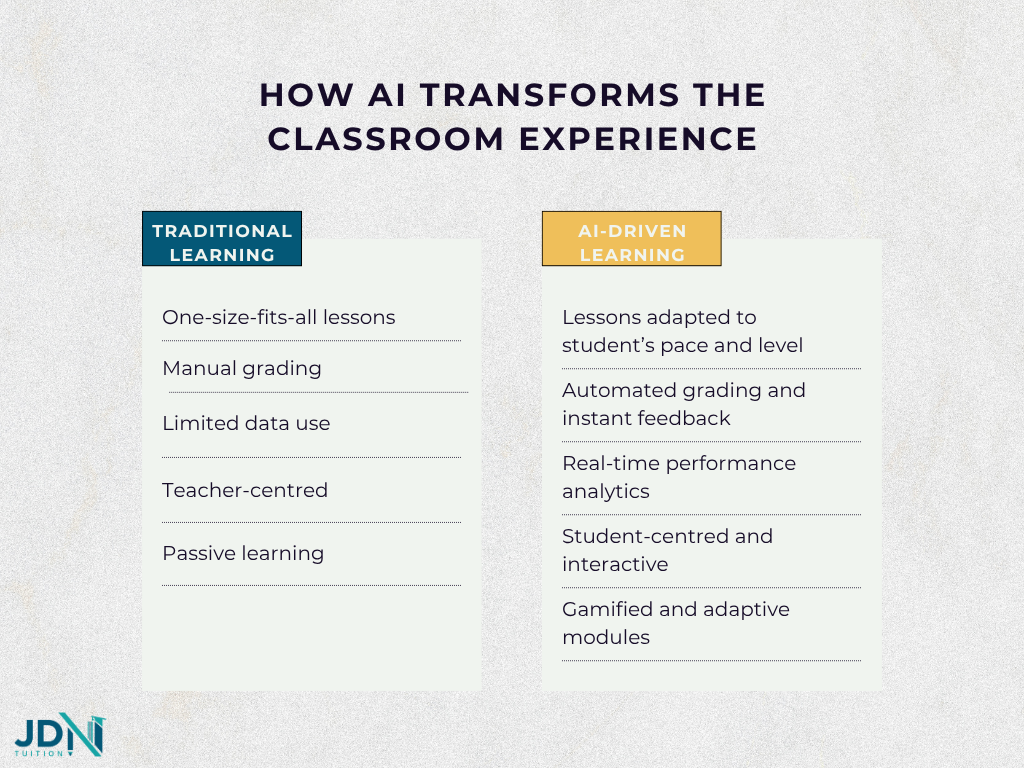
- Personalised lessons tailored to each student’s unique pace and abilities.
- Delivering instant feedback and support for students
- Automating administrative tasks for schools
Therefore, instead of taking the place of human teachers, AI technology works alongside them to enhance their efforts. Together, they are working to make learning more effective and accessible to students.
The Significance of AI in Education
The significance of AI in education goes far beyond being just a buzzword. AI is actually redefining how we perceive learning and teaching. Education has always faced various challenges, like unbalanced access, huge class sizes, and traditional and outdated teaching methods. Here is when AI comes to play and flips the game. Integration of AI systems provides innovative solutions to these challenges by;
- Making education personalised to the unique needs of learners
- Helping reduce teacher workload
- Strengthening student engagement
- Enhancing inclusive education for students with disabilities.
Hence, as the educational realm evolves to fulfil the needs of modern learners, artificial intelligence plays a pivotal role in improving the learning environment, supporting teachers, and extending equal access to quality education.
Key Roles AI is Playing in Education
1. Personalised Learning
One of the most promising roles of AI in digital learning is personalisation. AI in education helps facilitate personalised learning by tailoring content to students’ unique needs. This approach helps benefit students, teachers, and resource-constrained institutes. As we know, every student is unique and learns differently; however, old classrooms follow a one-size-fits-all teaching style. Therefore, the integration of artificial intelligence and education helps learners to learn at their own unique pace and speed. AI-driven systems help analyse a student’s strengths, weaknesses, and abilities. In addition to this, using AI tools to devise data-driven and adaptive lessons and quizzes improves the overall learning experience.
For instance, if a student struggles with Science and excels in reading, AI platforms will challenge him in reading, while giving him more practice in Science. Consequently, this unique approach ensures no student is left behind. Tools like Quizlet and Kangmigo play a major role in AI personalised learning of students.
2. Intelligent Tutoring System
AI acts as a tutor who is available 24/7. With the help of AI, online tutoring can provide adaptive and accessible learning experiences for students. AI-powered intelligent tutoring systems offer extra support outside the classroom in different ways. For example, these intelligent systems explain concepts to students in simple terms to improve conceptual understanding. AI helps provide practice exercises based on the learner’s progress to fill learning gaps. Additionally, AI systems solve student mysteries by instantly answering frequently asked questions. Additionally, this approach frees up teachers’ time by dealing with routine instructional tasks and providing data on students’ learning progress.
In short, this helps build a safety net for shy and slow learners, with minimal increase in the teachers’ workload.
3. Supporting Inclusive Education
Artificial intelligence (AI) has proven to be a pivotal instrument in the inclusive education landscape. AI in assistive technology helps offer a means to enhance accessibility and personalised learning experiences with students with disabilities. With the help of AI writing tools, students with different language proficiencies and learning challenges can get access to vocabulary and grammar support. According to scientific research, through the provision of adaptive materials, AI helps enhance accessibility for learners with disabilities. For example, AI helps visually impaired students through image descriptions and audio transcripts for students with hearing disabilities. According to the WHO Assistive Tech Report in 2022, over 2.5 billion people currently need at least one assistive product, and this number is expected to grow to 3.5 billion by 2050.
Moreover, integrating AI for learning helps enable instant and real-time feedback. It also makes features like speech-to-text tools, text-to-speech systems, and real-time language translators accessible to all students, regardless of their learning style. Therefore, by breaking communication and comprehension barriers, AI fosters equal educational opportunities for learners. This inclusivity in education helps empower teachers to focus on delivering better guidance and mentorship.
At JDN Tuition, we take into account our students from different backgrounds and their diverse needs. Our teachers incorporate modern techniques to help address different problems faced by different students. We promise to leave no stone unturned in facilitating your child.
4. Global Accessibility to Education
Over 250 million children globally lack access to school, and AI helps bridge this huge gap. With advancements in technology and development, AI supports global access to education by overcoming geographical, economic, and linguistic barriers. Through AI applications such as intelligent tutoring systems, automated translators, and adaptive strategies, learners worldwide can access quality education regardless of location.
The ability of artificial intelligence to redefine global education will become more evident as it develops. With AI integration, learners in remote and marginalised areas could also get access to quality resources.
Furthermore, artificial intelligence also provides scalable options. This includes virtual classrooms, intelligent assessments, and language support to offer equal opportunities for learners from underdeveloped areas. Consequently, AI is opening doors to education more than ever by removing traditional barriers and providing personalised learning opportunities.
5. Benefits of AI for Teachers
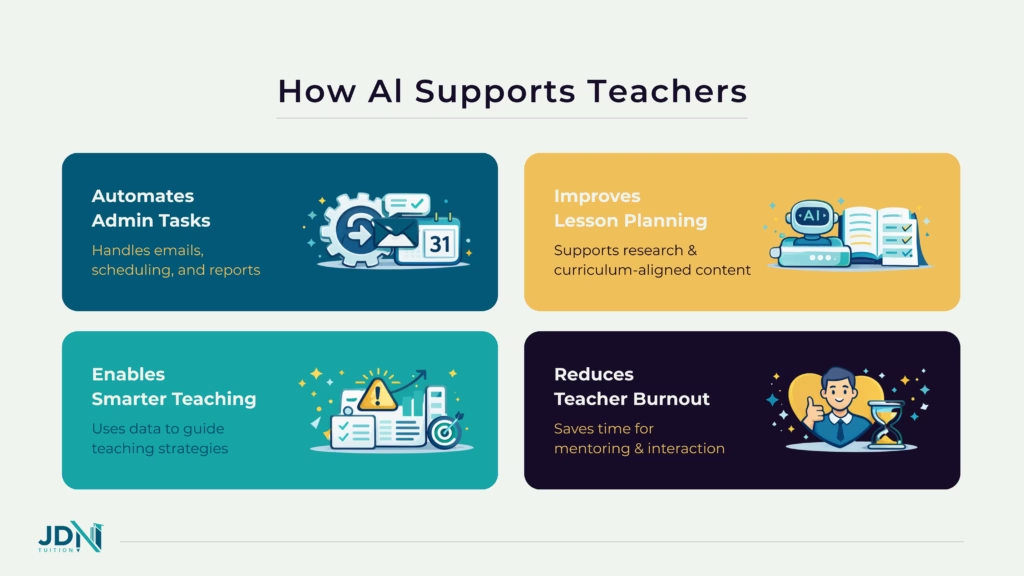
AI does not just help students, but it also helps teachers and school administration by automating administrative tasks. Institute administration can leverage AI-powered technologies to streamline various administrative tasks. AI-driven chatbots facilitate the process of drafting emails, scheduling meetings, and conducting professional sessions. Implementing AI in schools can help analyse large volumes of data to make informed decisions, like arranging summer camps based on parents’ opinions. Therefore, AI allows administrators to focus more on strategic initiatives and relationship-building.
Furthermore, the benefits of AI for teachers cannot be overstated. By using AI for research and content generation, educators can improve lesson quality without increasing their workload. As a result, this approach benefits learners, educators, and resource-constrained schools.
In addition to this, AI helps teachers by automatically grading multiple-choice or short questions. It helps generate students’ progress reports and track their attendance digitally, reducing manual workload for teachers. This reduces the risks of teacher burnout and enables them to focus on human interaction and mentoring.
AI does not just help students; it also significantly supports teachers. AI tools for teachers can help them recognize students who are at risk of falling behind. It helps teachers identify the best teaching strategies based on the type of subject and the students they are working with. With the help of AI teaching strategies, educators can enhance learning outcomes through AI-suggested interventions. AI tools enable teachers to develop content aligned with curriculum standards, ensuring that instructional material effectively meets the diverse needs of students. Teachers can use these intelligent technologies and data-driven insights to personalise learning paths and deliver adaptive feedback. This ultimately helps enhance the learning experience for students and the teaching experience for instructors.
Benefits of AI in Education
Let’s summarize the advantages that AI brings to education.
-
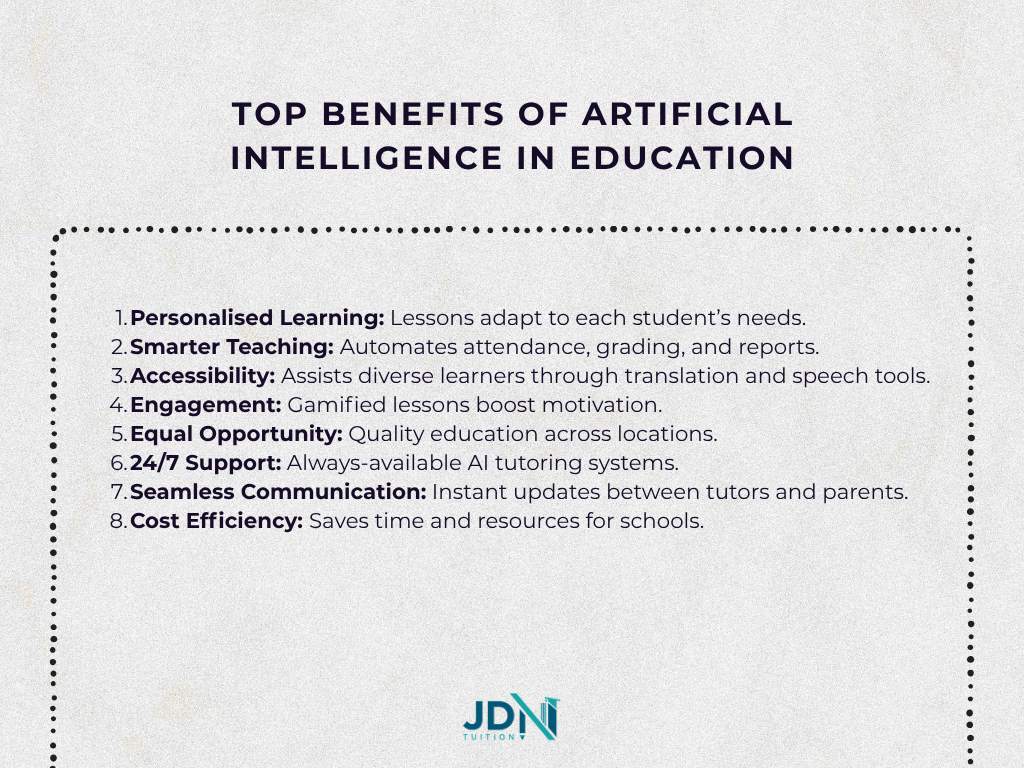
- Personalised Learning: Imagine your lessons are just designed as per your needs, speed, style, and pace. AI helps make your learning journey unique by improving the critical thinking skills of students.
- Efficient and Smarter Teaching: From digital attendance to grading to lesson planning, AI frees educators from the burden of repetitive tasks. So, it helps teachers focus on what really matters: mentoring and inspiring
- Accessibility: Whether it is text-to-speech tools, translations, or adaptive learning, AI ensures no student is left behind. Hence, AI makes education accessible for everyone.
- Student Engagement: Interactive simulations, gamified lessons, and virtual tutors at JDN Tuition make the learning experience exciting, keeping students hooked.
- Equal Opportunities: Regardless of your location and ethnic background, AI brings equal learning opportunities for all learners all around the globe.
- Extra Support: Stuck on a problem at midnight? Intelligent tutoring systems are there to help you anytime, anywhere. They are available 24/7, supporting students whenever they need help outside the classroom.
- Seamless Communication: AI chatbots and assistants keep the tutors, learners, and parents connected, ensuring no queries go unanswered.
- Cost-Efficiency: AI technologies help resource-constrained institutes cut administrative tasks while enhancing the quality of education, making quality education affordable for everyone.
Therefore, even though the implementation of AI technology comes with challenges, the benefits are too significant.
Challenges of AI in Education
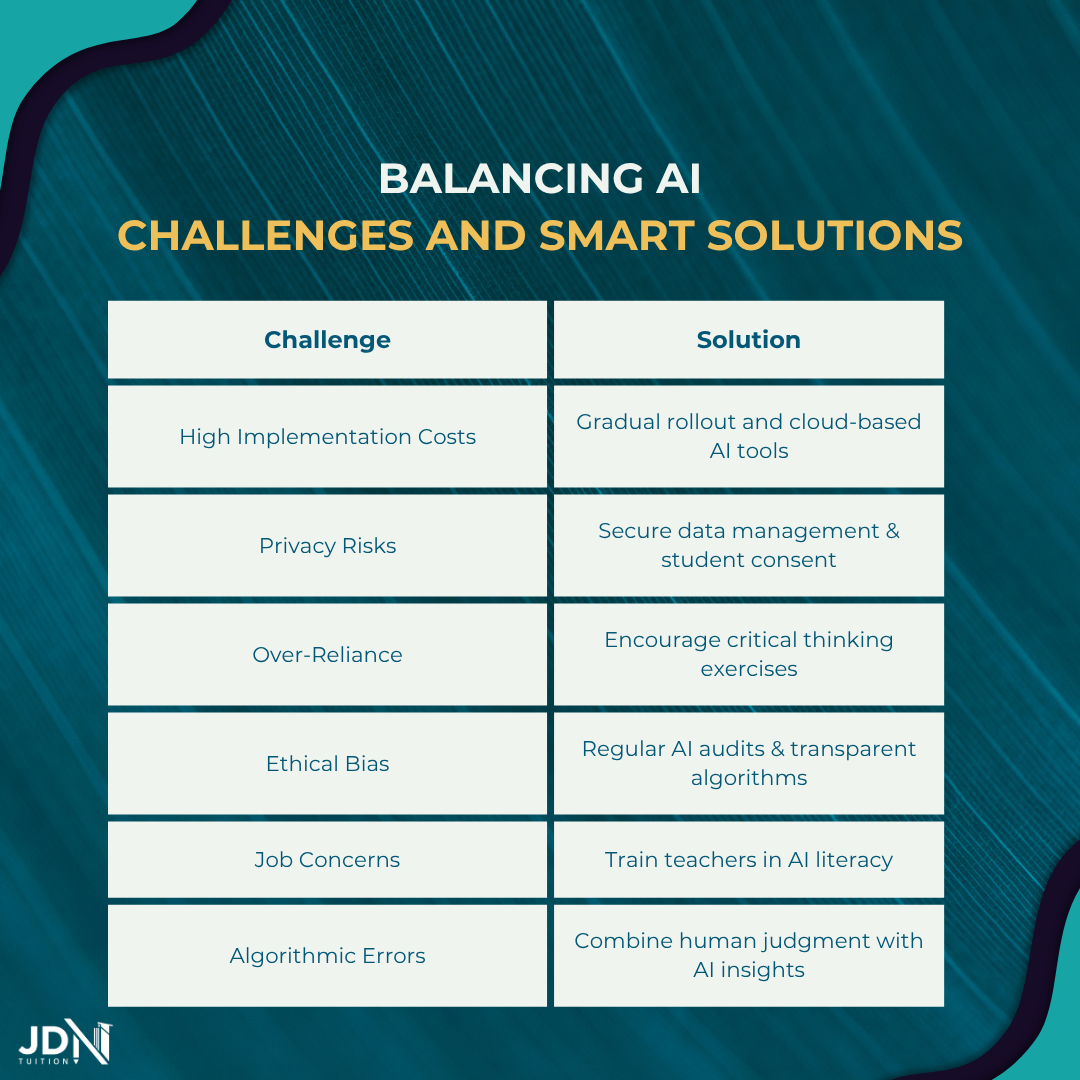
Along with numerous advantages of AI, various challenges also need to be addressed. Here are some of the challenges of integrating AI in education;
-
- Implementation Cost: Implementing AI and an advanced tutoring system can be expensive at the time of installation for resource-constrained institutes.
- Privacy Concerns: When sharing information with AI, students often overlook the fact that it stores this information. If the data is leaked, sensitive details can be released to the public. It is one of the most concerning challenges of AI.
- Over-Reliance: Dependence and over-reliance on AI might hinder or reduce critical thinking and problem-solving skills.
- Ethical Issues: Generative AI is one of the recent inventions, for which not all the legislations and policies have caught up. Questions about fairness, bias in algorithms, lack of human judgment remain.
- Human-AI Collaboration: Institutes may come across resistance to adopting artificial intelligence in education due to concerns of job displacement. However, AI is not a replacement for human creativity and emotions.
- Algorithmic Bias: AI learns from data, and if the data carries bias, the AI can unintentionally reinforce biased or unfair learning outcomes.
While AI brings an array of education benefits, its challenges remind us that technology should enhance human efforts– not replace them. You can refer to OECD AI principles for a better understanding of the ethical use of AI.
What Does the Future of AI in Education Hold?
Parents must be wondering what is going to be the future of artificial intelligence in education will be. So here is your answer. AI is not here to replace human effort; it is, in fact, going to enhance it. In the future, learners will be able to learn from human teachers as well as AI co-teachers. Furthermore, predictive analytics helps learners predict their career pathways based on their learning patterns. AI-powered voice students are going to help students with instant homework support. Moreover, students and learners from all over the globe can connect through AI using translation tools.
The goal is not to replace teachers but to empower them– helping them deliver more effective, engaging, and inclusive lectures.
Why JDN Tuition is Best for Your Kid?
At JDN Tuition, we strongly believe that every child deserves a learning experience tailored to their unique needs. That’s why our skilled tutors combine their teaching skills with the latest AI-powered tools to create lessons that are both personal and powerful. For students, this means better confidence, effective progress, and a deeper understanding of various subjects. For educators, AI-driven tools help reduce the stress of handling repetitive tasks, allowing them to concentrate on nurturing and mentoring young minds. Contact us today if you want to join the finest AI tutoring in Australia.
Parents can have complete peace of mind knowing that their child is in safe hands with JDN tutors. At JDN Tuition, every kid receives one-on-one attention, constant progress tracking, and appropriate resource accessibility that make the learning process impactful and engaging. Whether it is about preparing for your exams, grasping difficult concepts, or pushing forward with advanced learning, JDN Tuition guarantees growth at every step. Choose JDN Tuition–where attentive teaching meets smart technology. Connect with us and be a part of the JDN Tuition community, where we empower both students and teachers to bring out the best in them. To have insights into different topics, visit our blog page.
Stay connected with JDN Tuition—follow us on Facebook, Instagram, and LinkedIn for tips, updates, and reviews from parents.
Final Thoughts on AI in Education
The incorporation of AI is redefining education for learners as well as teachers. From personalising learning experiences to making education more engaging and accessible, AI is transforming educational dynamics. While challenges, like cost, privacy, and access, are there, the benefits are too significant to ignore.
Ultimately, artificial intelligence in education is not about replacing human teachers—it is about giving them better tools, reducing their workload, and helping students reach their full potential. Education has always been about unlocking possibilities, and with AI, those possibilities are greater than ever.
📞 Book a FREE Call: +61 2 7257 0299
📧 Email us: [email protected]
Which AI tool is the best for teachers?
It really depends on what teachers need the most help with. Both Canva AI and ChatGPT are strong contenders. ChatGPT is a flexible tool, great for generating ideas, writing drafts, and helping with details, etc. Teachers use it frequently as their time-saving partner. Other than this, Canva AI is also one of the best tools teachers can use to create full lesson plans with simple prompts.
Is AI good or bad for teachers?
Most of the teachers using AI tools say that AI is helping improve their quality of work. According to a survey, about 61% of teachers who use AI say that they get better insights into students' learning and achievement data. However, 57% of them feel their grading and student feedback abilities have improved with AI.
Will AI ever replace teachers?
AI will never really replace human teachers; it is there to enhance their efforts. AI cannot replace the human connection and guidance that teachers provide. Similarly, educators who actually care for their students’ success will always be indispensable.