



How Boredom Supports Child Development
Psychological Wellbeing | Problem Solving Skills | Brain Development
Discover why embracing boredom is actually a secret weapon for acing your exams and boosting creativity.
Picture this: You’re on the bus home from school. It’s been a long day of double Maths and an intense English assessment. You reach into your pocket to pull out your phone and doom-scroll through TikTok until you stop, but your fingers brush against cold glass. The screen is black. The battery is dead.
For most Australian students, this moment evokes a distinct kind of panic. What should you do with your hands? Where should you look? Suddenly, you must confront the one thing we have spent the last decade trying to eliminate from our lives: boredom.
In our modern “Attention Economy,” we treat silence and stillness as if they were physical injuries. Digital habits have conditioned us to fill every spare second with podcasts, Reels, or group chat notifications. We often equate “doing nothing” with “wasting time.” However, here’s a controversial truth that most productivity mentors won’t tell you. When we eliminate boredom, we might also limit our brilliance.
In this article, we’ll explore what boredom is and how, instead of harming your child, it can actually help them. Want to read more on how boredom helps your child grow? Check out our JDN Tuition Blog Page.
The Science of Boredom: What Happens When We Are Bored?
As a parent, you have likely heard the moan from the back seat of the car or the living room sofa: “Mum, Dad… I’m bored.” These symptoms of boredom are often said with the same urgency as a medical emergency. Our instinct, born of love and a desire to help, is to rush in with a solution. We suggest a book, hand over an iPad, or list chores until they miraculously find something else to do.
But before you rush to fill that silence, it is crucial to understand what is actually happening inside your teenager’s brain during these moments of boredom. The thing is, it’s actually not a bad thing to be bored.
There is a common misconception that when a student stops focusing on a specific task, whether that be solving a quadratic equation or writing a Modern History essay, their brain simply shuts off. We assume boredom is a lack of brain activity. However, neuroscientific research tells us the exact opposite is true.
When the brain does not focus on an external task, it activates a specific neural network called the “Default Mode Network (DMN).” You can think of the DMN as the brain’s “night shift” cleaning crew. When the noise of the day quiets down and the external stimulation stops, the DMN lights up to process information, consolidate memories, and reinforce good habits for the future.
If your child is constantly switching from schoolwork to social media to Netflix, their DMN never gets the chance to clock on. They are perpetually in ‘active’ mode, which is expensive for their cognitive function and exhausting. By denying them boredom, we are denying them the time required for the critical process where teenagers figure out who they are and what they want to do with their lives.
The Dopamine Detox
Beyond the DMN, there is the issue of chemical balance. We need to talk about dopamine.
Modern apps deliver short, sharp bursts of dopamine—the brain’s “reward” chemical—every few seconds. When a student spends hours on high-stimulation platforms like TikTok or video games, their brain adjusts its baseline for what it considers ‘interesting.’
Think of it like a diet. If your child eats nothing but super-sweet candy all day, a crisp apple will taste bland and unappealing. Similarly, when short-form videos overstimulate the brain, a textbook or a novel can feel painfully slow.
Boredom acts as a neurochemical reset, a way to improve your child’s control of self. By sitting with the feeling of boredom and refusing to soothe it with a screen, the brain’s dopamine tolerance lowers. Suddenly, the ‘slower’ activities like skill development, reading, or just having a conversation at the dinner table, become engaging again because the brain isn’t screaming for a higher hit.
Boredom vs. Burnout
If you walk into any Year 12 homeroom in Australia, you will notice a strange phenomenon: the “Busy” Badge of Honour. It’s almost a competitive sport.
“I only slept four hours last night because of that Biology report.” “Oh yeah? Well, I have three assignments due, tutoring tonight, and soccer training, and I haven’t eaten since breakfast.”
Somewhere along the line, we equated constant connectivity with true productivity. We equate movement with progress. But there is a massive difference between being busy and being effective. This is where the distinction between boredom and burnout becomes critical, highlighting the genuine importance of boredom in a balanced student life.
Understanding Stress: The Good, The Bad, and The Ugly
First, we need to correct a myth: stress isn’t inherently evil. Psychologists distinguish between different levels of stress. There is “distress,” which is the overwhelming, paralysing feeling that leads to burnout. But there is also eustress, a beneficial form of stress.
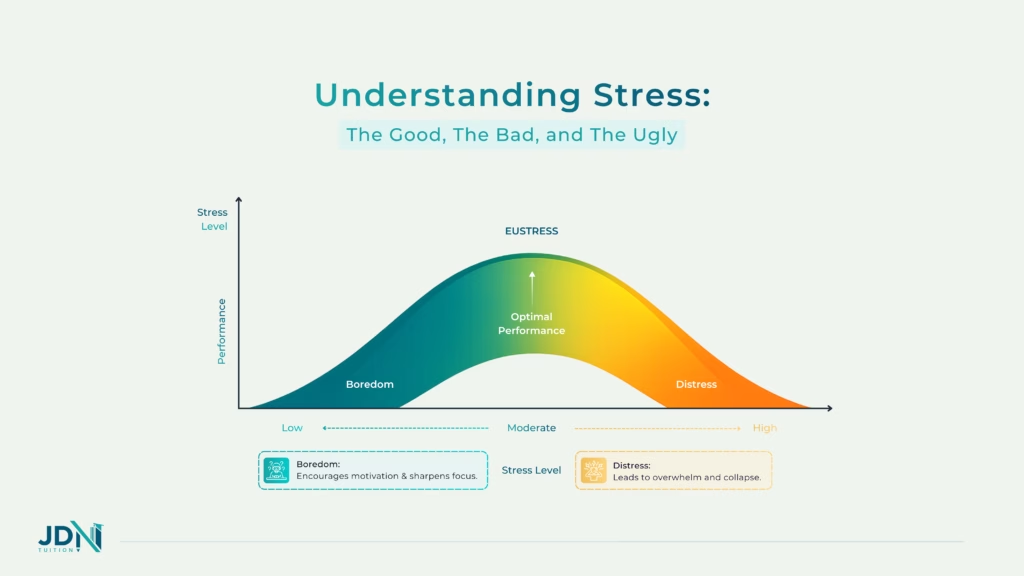
Eustress is that butterfly-in-the-stomach feeling before a debating final or the adrenaline spike that helps you focus during a timed maths exam. It motivates you and sharpens your performance. The problem is that without periods of downtime (boredom), your brain cannot reset from eustress back to baseline. Instead, it tips over into chronic distress or burnout.
When you burn out, you stop working. When you feel bored, you are simply waiting for the next task. One is a state of collapse; the other is a state of readiness. To avoid this collapse, students must proactively schedule ‘nothing’ into their calendars. By embracing quiet moments, you allow your nervous system to recover, ensuring that your next spike of eustress translates into high-level exam performance rather than mental exhaustion.
The Great Deception: Rest vs. Distraction
Here is the trap most students fall into: you finish a 45-minute study block, and for your “break,” you immediately open Instagram or YouTube. You think you are relaxing, but you are actually bombarding your visual cortex with high-speed information.
This is not rest; it is distraction.
One of the distinct benefits of boredom, whether that be sitting on the back deck staring at the trees, or lying on your floor listening to the hum of the fridge, allows your brain to engage its executive functioning skills. These are the CEO-level skills in your brain responsible for planning, organising, and emotional regulation. When you are constantly scrolling, your executive functions are offline. When you are bored, your brain activates to sort through the mental clutter of the day.
At JDN Tuition, we emphasize this constantly: the students who sustain high marks throughout the year aren’t necessarily the ones studying 24/7, but the ones who treat their rest as seriously as their revision. Take a look at our Google Business Profile and discover how we can help your child use their boredom to ace exams.
Boredom Builds Resilience
So what’s the reason behind why boredom is good for kids? It might sound strange, but being bored is also essential for their social development. How? Because the constant stimulation prevents you from processing your own emotions.
If you immediately distract yourself every time you feel sad, anxious, or lonely, you never learn how to self-soothe. You become reactive rather than reflective. When you allow yourself to be bored, you sit with your thoughts. You process social interactions from the school day. You also develop a stronger sense of self.
Furthermore, this downtime is the fuel for positive thinking. It is difficult to maintain a positive outlook when your brain feels like a browser with 50 tabs open. Boredom closes the tabs. It clears the RAM. It creates the mental space required to shift your perspective from “I have to do this work” to “I can handle this.” Once you stop force-feeding your brain data, you allow it to synthesize what you’ve learned, which is exactly when your creative skills ignite.
Why Boredom is Your Secret Weapon for Exams?
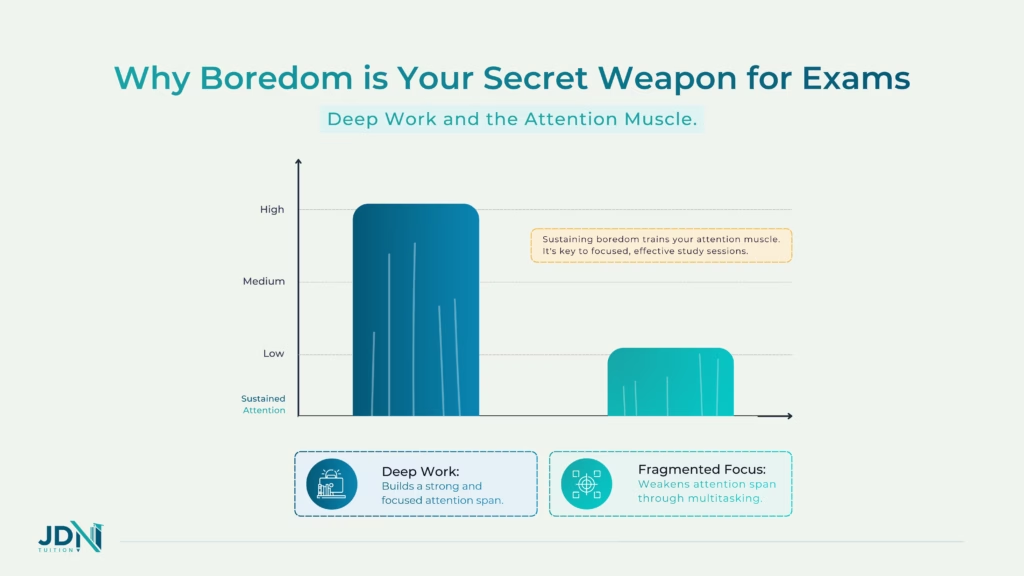
Deep Work and the Attention Muscle
To succeed in senior years, you need to master “Deep Work”. This is the ability to focus without distraction on a cognitively demanding task.
Embracing boredom acts as a form of resistance training for your attention span. It is one of the most underrated study techniques available. By letting yourself be under-stimulated during downtime, you reduce your need for constant “entertainment.” This makes the relatively dry task of memorising Biology definitions feel less painful and more manageable. In this sense, boredom supports healthy child development by teaching the brain to sustain attention on things that aren’t immediately rewarding.
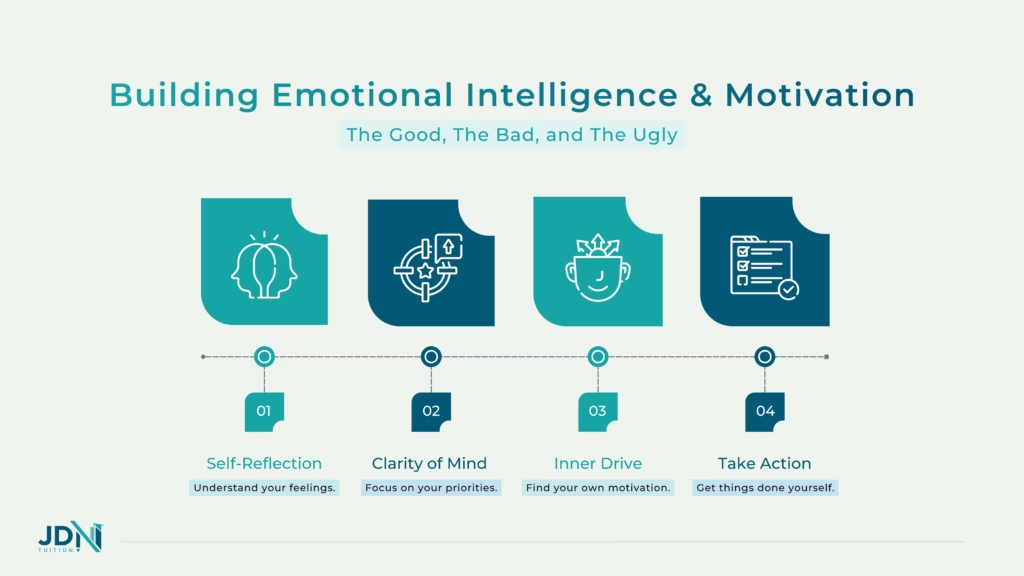
Building Emotional Intelligence and Motivation
Finally, boredom forces you to confront yourself. When you aren’t consuming someone else’s content, you are left with your own thoughts. This builds emotional intelligence because you are forced to acknowledge how you are feeling about your workload, your friendships, or your future.
It also drives self motivation. When the external entertainment stops, the motivation to do something must come from within. You might pick up a guitar, reorganise your notes, or plan your week just to alleviate the boredom. This internal drive is far more sustainable than the fleeting motivation you get from a “study with me” YouTube video. By mastering this stillness, you transform boredom from a distraction into a powerful academic tool that sharpens your concentration for exams and long-term learning.
How JDN Tuition Can Help You Take Advantage of Boredom
You might be thinking, “I don’t have time to be bored!” Here’s the paradox: to reap the benefits of downtime, you must use your active time efficiently. This is where JDN Tuition bridges the gap.
Our philosophy of holistic education acknowledges that a student who is studying 24/7 is a student who is failing to consolidate memory. We provide high school private tutoring that optimises your study hours, using teaching methods that speed up understanding so your child can afford to close the books and stare at the wall for a while.
We facilitate this by:
- Offering high school tutoring that focuses on conceptual mastery, reducing the time your child spends struggling with basic content.
- Designing personalised learning plans that target your child’s specific gaps, ensuring you aren’t wasting hours reviewing what you already know.
- Matching students with mentors who possess effective communication skills, meaning you learn faster and retain more.
- Encouraging mindfulness activities as part of a balanced schedule, rather than just piling on more homework.
Our approach goes beyond traditional rote learning by teaching students how to study smarter, not longer. By streamlining your academic load with our tutoring services, we give you back the most precious resource of all: time. Time to relax, time to reset, and time to be bored.
Conclusion: How Boredom Helps Children Grow
Ultimately, boredom is a tool you and your child can take advantage of both in the exam room and in their future. People often see it as a complaint and something they must remove from a child’s mind. However, under the right circumstances, it can be incredibly useful.
Whether you’re trying to use it in the exam room or just want to understand how boredom can be useful to you, knowing how to use it is always worthwhile. The ability to harness boredom, however, can be incredibly tricky. That is where JDN Tuition can help you.
Ready to stop spinning your wheels and start using boredom more smartly? Contact us today and check out our reviews to create a schedule that balances high performance with healthy boredom. Alternatively, call us now to reclaim your focus and turn your downtime into your greatest competitive advantage.
Improve Results. Start Today.
📞 Book a FREE Call: (02) 7257 0299
📧 Email us: contact@jdntuition.com.au
How does boredom benefit kids?
Boredom benefits kids by activating the brain’s Default Mode Network, which is essential for creativity and complex problem solving. It also encourages independence, as children learn to rely on their own internal resources rather than screens for entertainment.
What are the benefits of boredom?
The key benefits include a neurochemical reset that lowers dopamine tolerance, making study and reading feel less like a chore. Additionally, it prevents burnout by giving the brain’s executive functions critical time to rest and reorganize.
Do intelligent kids get bored easily?
Highly intelligent students often get bored when the curriculum moves too slowly. However, they are usually good at entertaining themselves with their own thoughts. If a student is constantly bored in class, it may be a sign that they need more advanced challenges. They may also benefit from a more tailored approach to learning.