





Struggling with HSC Business Studies Essays? Avoid These Common Mistakes
HSC Business Studies Past Exams | Executive Summary | Business Reports
For a lot of Year 12 students, the HSC business studies exam is one of the most stressful and challenging areas of their senior year. Business studies essay, in particular, is of high stakes: it assesses not just how much you’ve memorized, but how well you can implement business management theories, evaluate and assess strategies, and communicate ideas unambiguously.
However, even well-prepared students often lose marks due to small yet avoidable mistakes in their business study essay.
This article will be your guide on what common mistakes students make in the HSC Business Studies essay, and how you can avoid those mistakes. As we move through the blog, we’ll also share impactful tips – from effective study methods like mind mapping to practical techniques like preparing an executive summary of your essay – that will help you write an essay confidently.
Why do Students Lose Marks in HSC Business Studies Essay?
According to the markers who have marked thousands of HSC exams, most of the errors students make are not about “knowing nothing”. Instead, they are mostly because of poor exam techniques, faulty time management, misinterpreting the question, or weak essay structure.
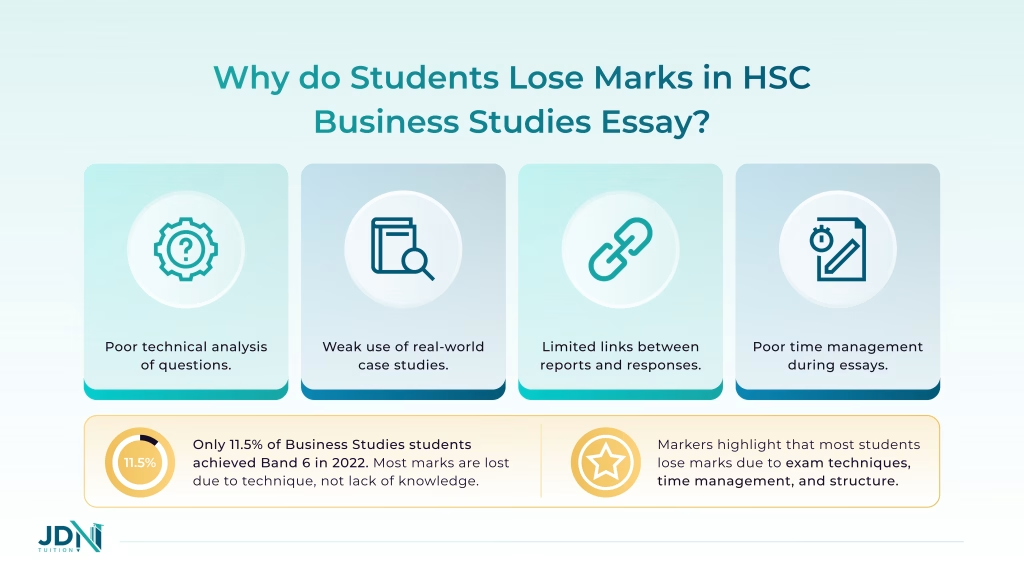
In fact, according to a report from NESA in 2022, it was found that only 11.5% of Business Studies students were able to achieve Band 6. It clearly means that a vast majority of students are losing their marks in essay-style questions despite having prepared the entire syllabus.
Other common issues due to which students end up losing their marks are;
- Poor technical analysis of the question
- Poor use of real-world case studies
- Inability to build a link or association between responses and business reports
- Poor time management and an incomplete answer to the question.
Comprehending these pitfalls and adopting effective study techniques to overcome them is crucial for boosting performance.
Why Do These Mistakes Matter for Students?
Before we dive deeper into what mistakes students make, it is worth emphasizing why students need to avoid them. Here is why it is important to avoid these mistakes;
- Even if the content you’ve written is good, poor structure and unclear argument can cost you a lot of marks.
- In the HSC Business Studies exam, the essay often makes the difference between a ‘Band 6’ and a ‘Band 5’ level answer.
- Mistakes in presentation or technique are avoidable, so eliminating them can give a great boost to your marks.
According to a marker who has graded thousands of HSC papers, many good student lose their marks simply because of technique and presentation. In this era of mobile phones and laptops, students often neglect their handwriting. Remember, someone has to assess every word you write, so make sure it is readable.
At JDN Tuition, our experienced coaches ensure that your kid’s exam has a good presentation because we believe that with a well-structured essay, a well-presented essay acts as a cherry on top.
5 Major Mistakes Students Make in HSC Business Studies Essay
When it comes to HSC exams, students face considerable pressure to prepare for them. There are a lot of mistakes made by students in their HSC Business Studies essays. Here are the most common ones.
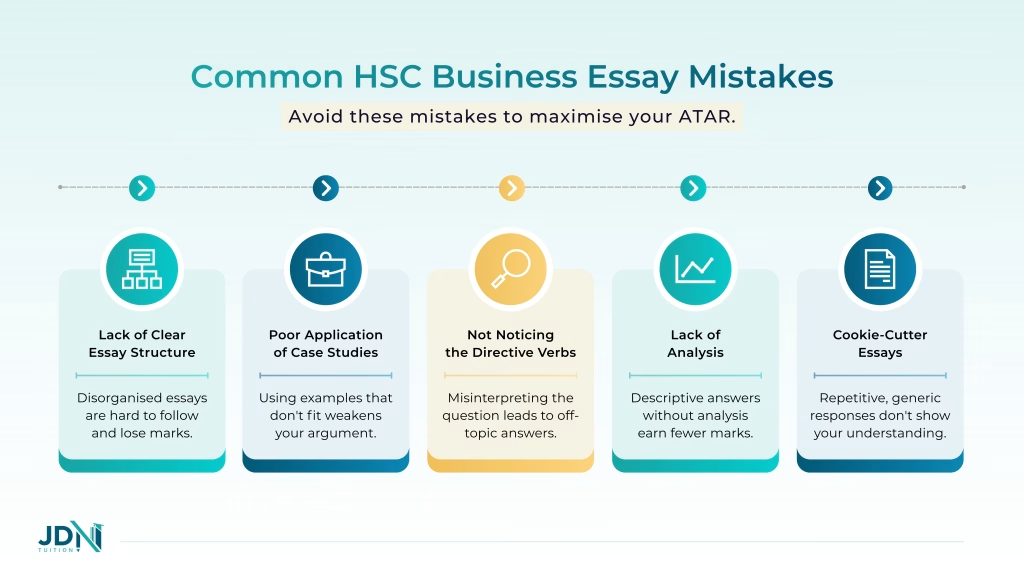
1. Lack of Clear Essay Structure
Imagine that you have studied the entire syllabus and spent hours taking notes, but if your HSC business study essay is poorly structured, your hard work may not pay off. One of the most common and significant pitfalls in the HSC Business Studies essay is poor essay structure. According to the HSC exam markers, many students save the essay for last because it feels the most daunting, but it often backfires.
Imagine a student whose concepts about every topic are clear, yet he jumbles ideas without linking them to the question. It results in a weakened argument, markers getting lost, and scores dropping. A strong essay structure demonstrates a logical flow, just like knowing how to write a business report: introduction, content body, and conclusion perfectly synced. Furthermore, in many scenarios, students tend to fit every piece of knowledge they have learned into one response. This also results in a long yet unfocused essay. HSC examiners look for clarity and coherence in your responses, especially in essay writing. Each paragraph of your essay should contribute to the central argument. Without a proper structure, even strong and informative content would become difficult to follow.
According to an examiner who has graded thousands of HSC exams, failing to plan is actually planning to fail.
HOW TO AVOID THESE MISTAKES?
- There are two ways to attempt an HSC Business Studies essay. It is either 70% case studies and 30% theory explanation, or 30% case studies and 70% theory explanation. If attempted well, with proper planning, either approach is fine.
- You must also jot down all the syllabus dot points relevant to the question. This will help you build a connection between different syllabus dot points to deliver a better and well-structured answer. You can also use the PEEL method (Point, Evidence, Explain, Link) to ensure that every paragraph has a purpose and is linked to the overall essay question.
- Use the executive summary style of business writing as your inspiration. Begin with a clear thesis statement that outlines your argument, essay body, and roadmap.
- A good essay writing practice includes essay scaffolding. Treat it like preparing a business report– structured headings, logical flow, and evidence-based analysis.
2. Faulty Application of Case Studies
Students might ace the HSC trials and cram the entire HSC syllabus inside out, but weak application of case studies can steal marks.
Picture this: a student writes a well-explained theoretical information, but provides vague and unclear case study references, such as “McDonald’s is a multinational food company.” While true, this adds little to no value to your essay. Illustrating McDonald’s business strategies clearly is what matters when it comes to your HSC Business Study essay.
HOW TO AVOID THESE MISTAKES?
- Most of the HSC examiners prefer more than one case study in your essay (usually three, or one case study for each paragraph). Additionally, use the real-life large businesses, like McDonald’s, Apple, etc, for which a great deal of information is available. Also, try to incorporate the most recent issues and events happened in that business.
- Students are required to directly link the case to the theoretical part. For instance, you can better explain the above-mentioned case study. Here is how: “McDonald’s integration of digital kiosks demonstrates the adoption of business analytics into operations. It allows the company to track purchasing patterns and improve the customer experience as per their preferences.”
- According to the HSC marking criteria, students should incorporate contemporary examples as their case studies. For instance, referencing Apple’s supply chain shifts, Woolworth’s sustainability report, or Qantas (HR and operations).
- Do the technical analysis. It means, do not just describe what a company or business did– analyze it and explain why it matters in the context of theory.
Why is it important to use real-world examples? Picture it this way: Would you trust someone who tells you how a business strategy worked for a hypothetical business when it didn’t really happen in real life?
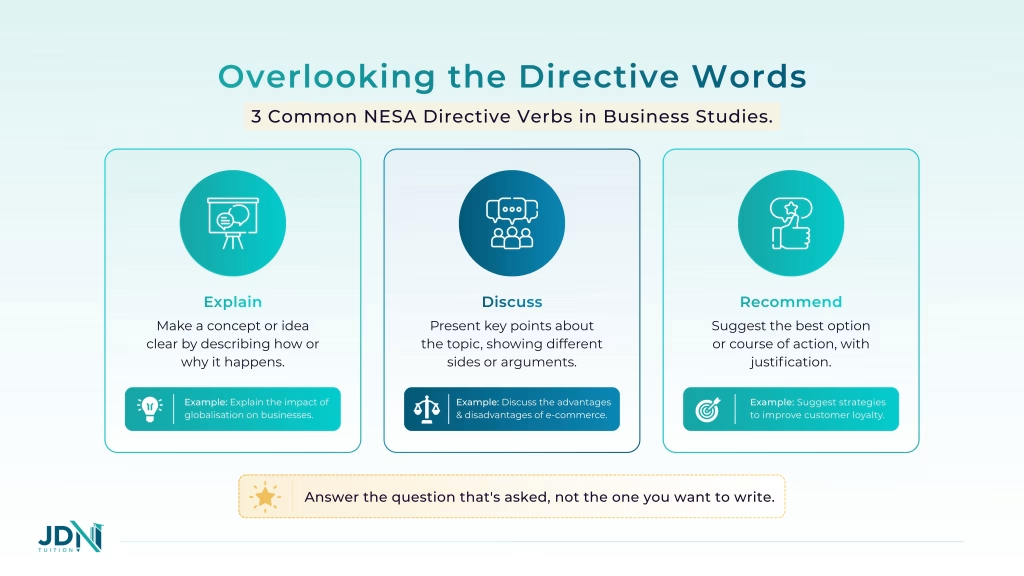
3. Overlooking the Directive Words
It is one of the important business writing mistakes. Directive words such as ‘evaluate’, ‘assess’, ‘interpret’, or ‘discuss’ hold a significant importance in the essay question. These words are considered central to the HSC business study essay question; however, students often ignore them. Missing these cues makes you ignore using technical terms, which results in your argument’s weakened precision and depth. For example, when a question asks you to ‘evaluate’ and you just ‘explain’, it will cost you your marks. Consequently, it results in essays that are more like a descriptive explanation than an analytical one.
HOW TO AVOID THESE MISTAKES?
- During the preparation for the HSC Business Studies exam, it is important to understand the NESA glossary of key terms. This will help determine the depth of your answer.
- Break down your question before writing the essay. Also, highlight the directive verb and identify what it wants exactly.
- Students may experience a freeze response due to exam anxiety, which is very normal for you to feel. However, this can be overcome by taking small steps to convert stress into balanced decisions. This means pausing for one or two minutes before outlining your argument. This freezing momentarily helps you avoid rushing into irrelevant content.
- Include practising these directive verbs with different case studies in your regular study plan before exams. For example, ‘evaluate Apple’s marketing strategy’ should include judgment– what worked, what didn’t, and why.
4. Lack of In-Depth Analysis
A great number of students tend to provide surface-level answers without deeper insights. For instance, they might describe, ‘Globalisation influences operations.’ However, they might not fully explain how globalisation redefines supply chains, technology, and costs in business operations.
HOW TO AVOID THESE MISTAKES?
- Adopt the mindset of business management (VCE) subjects, where detailed reasoning and evaluation are highlighted. Instead of just one-sentence answers or explanations, use multi-layer explanations to build a strong thesis for your essay.
- Students are urged to use qualifiers and intensifiers (e.g., to a great extent, significantly, is ineffective) to craft an essay of Band 6 level.
- In your daily schedule planner for revisions, include frameworks like SWOT or PESTLE. These frameworks help ensure that your answer covers multiple aspects, like political, financial, social, etc.
At JDN Tuition, we help struggling students in a number of ways. One of them is urging them to think like an examiner. They should ask themselves, “Would a real-world businessperson make a decision based on your answer?” If not, teachers encourage them to add more reasoning to their responses.
5. Over-Reliance on “Cookie-Cutter” Essays
HSC examiners report that they often see students relying on pre-prepared model essays. While it is really important to have a deep understanding of your syllabus, a “cookie-cutter” essay or response that does not really answer the question will not earn you a good score.
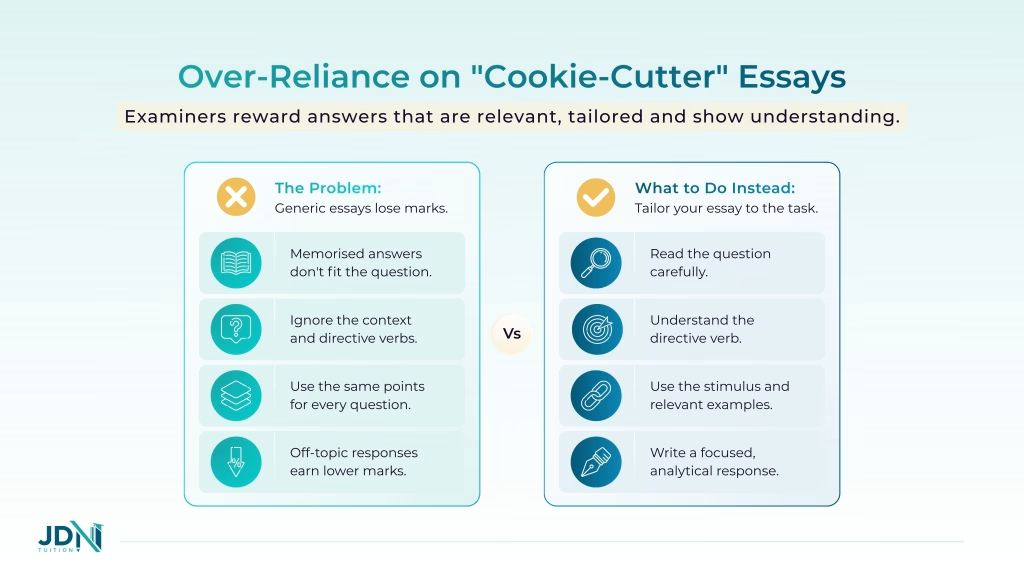
For example, a student may memorise an essay on Apple’s marketing strategy but be asked about strategies for improving financial performance in global markets. If they reproduce the memorised content without addressing “global markets,” the response may be considered irrelevant.
HOW TO AVOID THESE MISTAKES?
- Students should practise adapting knowledge to different questions. While revising, reframe the HSC Business Studies past papers and ask yourself some guiding questions, such as “How could I use my learnt knowledge to answer this question differently?”
- Students are recommended to focus on business analytics to interpret data and recent trends. For example, while referring to financial strategies, discuss the real-world profit margins and share price movements. This shows genuine understanding rather than rote learning of the whole syllabus.
- Standout and Band 6 essays begin with a clear and strong thesis in the introduction. This sets the tone for the rest of the essay and gives the examiner an idea about what to expect.
- Always reference any stimulus period provided, and use relevant examples or case studies to prove your point. Also, keep the case study knowledge flexible. Instead of depending on cookie-cutter responses, break the case studies according to themes (e.g., operations, marketing strategies, financial outcomes). This approach will allow you to apply them across multiple questions.
HSC Business Studies Essay Mistakes and Solutions in a Nutshell

The HSC Business Studies essay is not just a test for students’ memory– it is an assessment of analysis, critical thinking, and communication. Students who avoid some common yet fixable mistakes, like unclear structure, over-reliance on memorised content, and improper use of case studies, can significantly improve their marks. By integrating the right use of jargon, implementing the proper use of transitions, and through proper mentoring, these business writing mistakes can be avoided. By adopting effective study strategies and time management in their daily and weekly study schedules, students not only prepare themselves for exams but also for future academic and professional challenges.
Why Choose JDN Tuition For Business Studies Preparation?
At JDN Tuition, we prepare students to ace Business Studies exams especially essays by teaching clear structure, strong case study application, and impactful writing strategies. Our expert teachers go beyond academics, providing stress-management techniques, personalised support, and encouragement to nurture the mental health of students during exams. With a balance of knowledge and confidence, students walk into their HSC fully prepared.
We tailor study plans for every student by taking into account their unique strengths and weaknesses. Contact us today to unlock your ultimate potential. To have detailed insights into different topics, visit our blog page.
Stay connected with JDN Tuition—follow us on Facebook, Instagram, and LinkedIn for tips, updates, and reviews.
Boost Confidence. Improve Results. Start Today.
 Book a FREE Call: +61 2 7202 1930
 Email us: contact@jdntuition.com.au
What is the hardest subject in business?
The hardest subjects depend on a student’s strengths and weaknesses. However, Accounting is widely regarded as one of the ‘hardest’ majors in business. It demands mastering complex financial rules, precise calculations, and critical analysis while applying strict professional standards.
How to master the business studies subject?
Join group discussions and study with peers to make tough topics easier to understand. Practise applying business theories to real-world situations using case studies and simulations. Build a clear study routine that includes revision tools like flashcards and interactive learning techniques.
Is business studies a good career?
Business studies is a good career choice because it helps build skills in management, finance, and problem-solving that apply across various industries. It opens pathways into diverse fields like marketing, entrepreneurship, consulting, and corporate leadership. With global demand for business expertise, it offers both stability and growth opportunities. The degree is also ideal for individuals planning to start their own business.