




What Are the Best Study Techniques for Year 7 to 10 Students?
Study Methods | Child Development | Study Skills
The best study techniques for Year 7 to 10 students are active recall, spaced repetition, mind mapping and regular practice tests, backed by a steady routine and good time management. This guide from JDN Tuition explains each one, along with note-taking and motivation, so parents can reinforce the same habits at home between lessons and help their child build lasting study confidence.
The jump from primary school to high school is bigger than most students expect. More subjects, higher expectations and tighter deadlines all arrive at the same time. Students who have a clear plan find the transition far more manageable. Strong study skills are what keep them confident and on track across every subject.
The great news is that knowing how to study effectively is something any student can learn. It is built through consistent habits, smart strategies and a little support from home. A focused approach matters far more than extra hours spent at the desk.
For more help for parents and students, take a look at the JDN Tuition Blog Page.
Why Do Strong Study Skills Matter for Your Child’s Future?
Strong study habits are one of the most valuable things your child can build during their school years.
Academic success is just one part of the picture. Structured study supports child development in ways that extend far beyond the classroom. Students who study consistently develop stronger concentration, greater resilience and a genuine sense of accomplishment.
Building self-discipline through regular study also prepares your child for adult life. The ability to sit down, focus and follow through on a task is something employers and universities actively look for. It forms gradually through repetition and practice across years of schooling.
A positive classroom environment plays a strong supporting role. When teachers set clear expectations and students feel engaged, good habits take hold more naturally. Parents can reinforce that environment at home by staying genuinely interested in what their child is learning each week.
Strong learning skills are tools your child will carry into every stage of life. A clear study guide for teens gives students a concrete starting point. It turns an overwhelming workload into a manageable series of achievable steps.
The habits your child builds today directly shape the student and the professional they will become.
How Can Your Child Build a Study Routine That Sticks?
A consistent study routine is the foundation your child needs before any other technique can work.
Many students sit down to study without a clear direction and waste the first twenty minutes deciding what to tackle. A study plan solves this. It gives your child a clear set of priorities before they even open a textbook. Planning ahead removes the mental friction that makes getting started so difficult. A good plan breaks tasks down into specific, achievable goals for each session.
A study timetable takes things one step further. It maps out which subjects get attention on which days and for how long. Knowing how to create a study schedule that balances all subjects is a habit that pays off across the entire school year. Encourage your child to block out dedicated study time in the same way they would schedule sport or music practice.
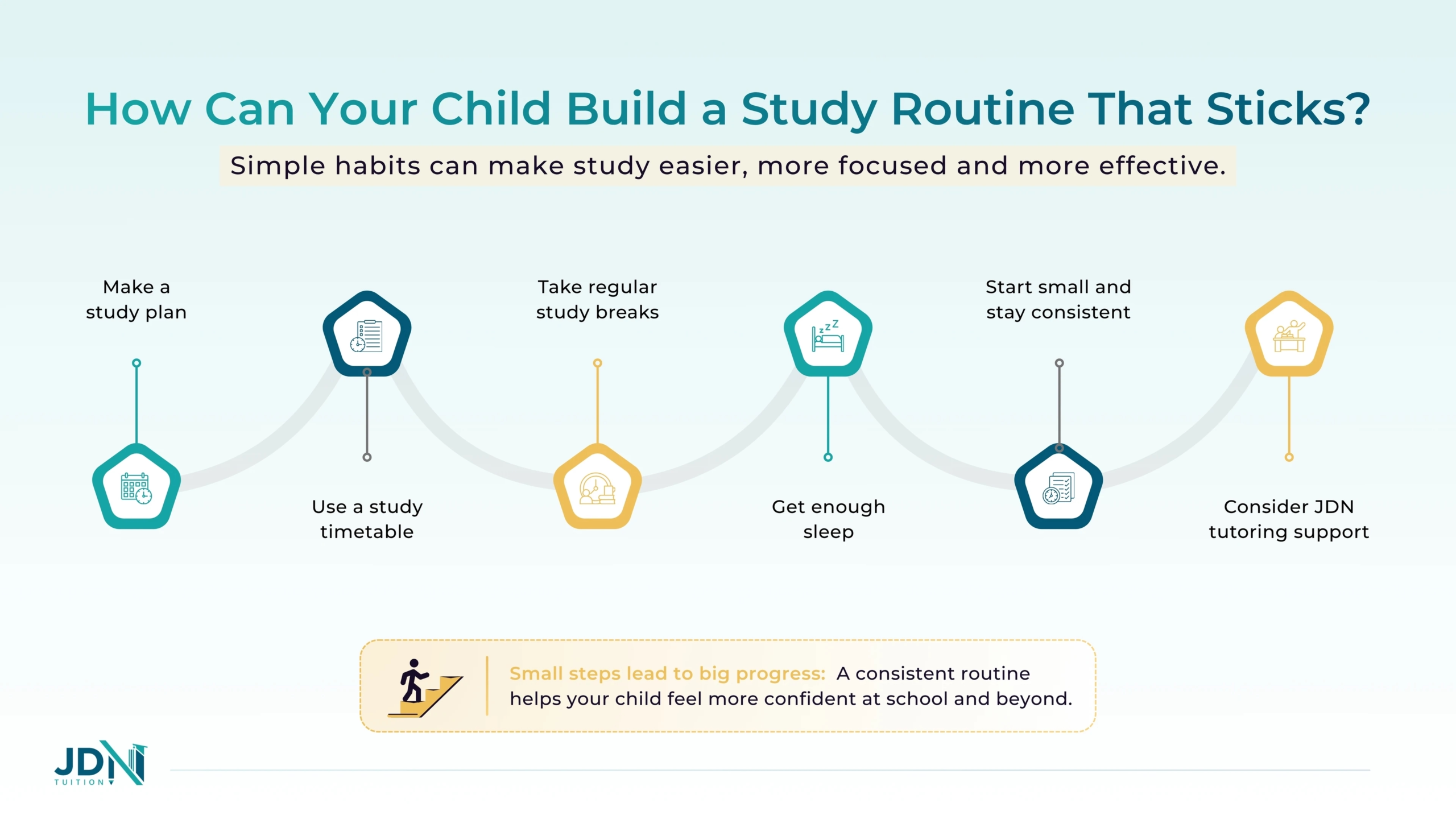
One thing parents often overlook is the value of study breaks. Regular short breaks help students recharge and work better when they return, and the right length for a study block differs from child to child. Encourage your child to step away from the desk, get some water and move briefly before returning to work. Breaks are productive, not a distraction.
Healthy sleep habits are just as important as study hours. Teenagers need around eight to 10 hours of sleep a night. Consistent bedtimes during the school week help protect focus, memory and mood.
Starting small helps too. Even fifteen minutes of structured study each evening builds the habit over time. Consistency across a whole term matters far more than the occasional marathon session.
If a younger brother or sister is still in primary school, primary school tutoring builds these same habits early, so high school starts on firm ground.
Does your child need help putting these ideas into practice? JDN Tuition offers High School Tutoring with the same tutor every lesson and a note after every lesson, so you can see exactly what your child worked on. Call or text 0485 952 515 or book a session to get started.
What Study Techniques Work Best for Years 7 to 10?
The best ways to study have less to do with time spent and more to do with using the right techniques. Below are four study techniques that really work.
How Do Active Learning and Active Recall Help?
Active learning and active recall help students remember more because they make the brain work with the material instead of just looking at it.
Passive re-reading and highlighting give students a false sense of progress. Active learning means engaging with material directly. Students ask questions, summarise content in their own words and connect new ideas to what they already know. This builds genuine understanding rather than surface familiarity.
Active recall study methods take engagement even further. Rather than re-reading notes, students test themselves on the content. This forces the brain to actively retrieve information, which strengthens memory significantly over time. Flashcards, self-testing quizzes and teaching material aloud to someone else are all powerful forms of active recall.
What Is the Best Way to Memorise Content Confidently?
Spaced repetition is one of the most reliable ways to memorise content, especially if your child has time before their assessment.
Knowing how to memorise content confidently makes exam preparation far less stressful. Several memory techniques are particularly well-suited to students in Years 7 to 10.
Spaced repetition involves reviewing content at gradually increasing time intervals, and the loci method links facts to familiar locations within an imagined space. Spacing out practice works better than cramming the night before an exam. Encourage your child to experiment and discover what sticks best for them.
What Is Mind Mapping?
Mind mapping is a way of laying out a topic as a diagram, with the main idea in the centre and related ideas branching out from it. A mind map is quick to read, so your child can revisit a whole topic at a glance.
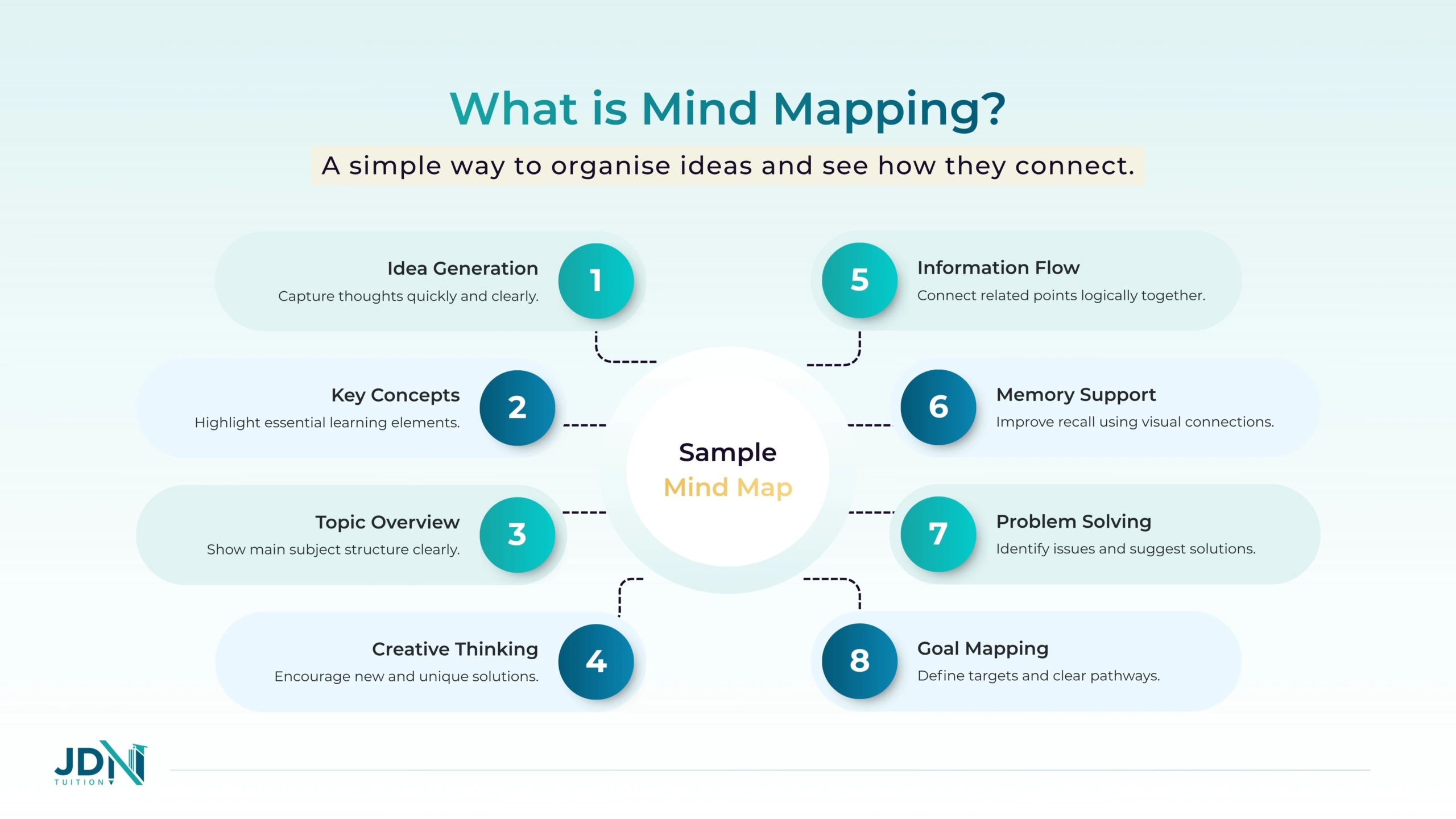
Mind mapping helps students see how ideas connect across a whole topic. Starting from a central concept and branching outward, students create a visual summary of everything they know. This technique works particularly well for humanities, science and any subject involving relationships between ideas. It is also an excellent planning tool for essay writing.
How Can Practice Tests and Revision Techniques Help Your Child?
Practice tests are among the most powerful tools available to any student. They replicate exam conditions, reveal knowledge gaps and build genuine confidence before the real thing.
Strong revision techniques compound these results even further. The Pomodoro technique, where students work in focused 25-minute blocks with short breaks, prevents mental fatigue during longer sessions. Interleaved practice, where students alternate between two or three subjects, keeps the brain actively engaged rather than running on autopilot.
Together, these are effective study methods your child can mix and match. Encourage them to trial a few across different subjects. Most students settle on two or three study strategies that suit them best, and those become a personalised routine they own.
Which Time Management Strategies Help Your Child Stay on Top of Their Work?
Good habits for managing time help your child stay on top of their workload before stress takes hold.

Many students fall behind because they struggle to manage their time across multiple subjects. Learning how to stop procrastinating is one of the most practical skills your child can develop during high school. Breaking larger tasks into smaller, specific steps makes getting started far easier. Completing one step builds the momentum to tackle the next.
Deadlines give students a clear structure to plan backwards from. NAPLAN preparation tips often centre on exactly this principle. Students who spread preparation across several weeks arrive at the test confident rather than rushed. Consistent, structured effort helps students feel prepared for NAPLAN, and our guide to NAPLAN results explains what the reports show.
If one subject is the sticking point, focused help in that subject can make the work feel more manageable. Maths tutoring is one way to give students in Years 7 to 10 subject-specific support.
If your child has started to fall behind, steady support from the same tutor each week can help them catch up. JDN Tuition offers Year 7 to 10 students online tutoring or home-based tutoring, and our parent reviews come from families who have already found the right fit for their child.
How Does Note-Taking Help Your Child Actually Learn?
Knowing how to take notes properly makes a genuine difference to how well your child retains what they learn.
Many students copy content word for word and assume this counts as studying. Passive copying rarely builds genuine understanding. Effective note-taking requires your child to engage with the material and summarise key ideas in their own words.
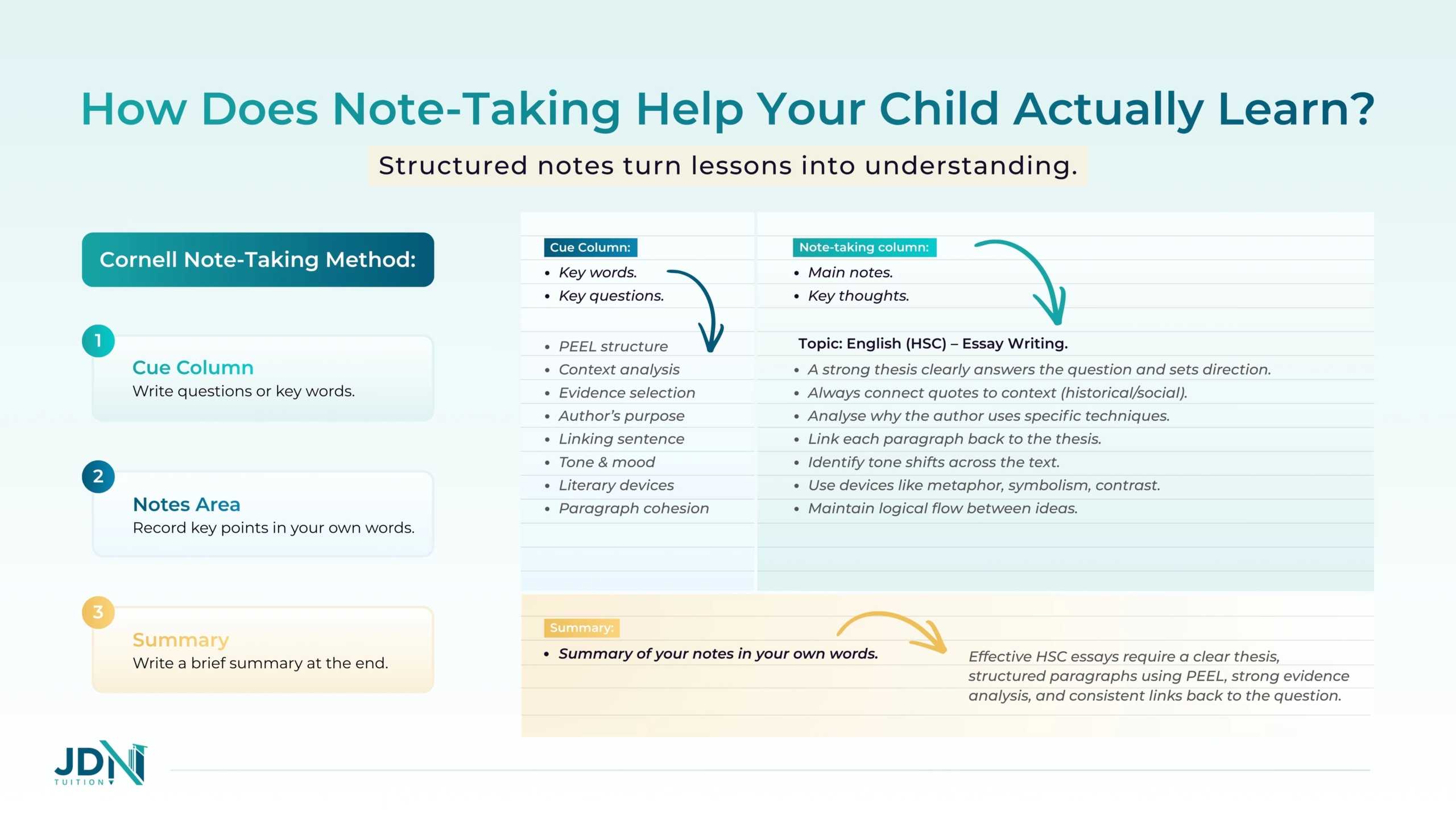
Several structured methods help students build this skill. The Cornell method splits the page into a notes area, a cue column and a brief summary section. Students record key points in the notes area and write questions in the cue column. A short summary sits at the bottom of the page. Bullet summaries work well for students who prefer a stripped-back approach. Visual diagrams suit learners who think in pictures and patterns.
Active reading pairs naturally with strong note-taking habits. Encourage your child to read with a clear purpose before putting pen to paper. Pausing to summarise each section, underlining key terms and writing margin notes all build comprehension as they go. This simple habit turns reading time into productive study time.
A quick review of notes within 24 hours of a lesson helps the material stick. Fresh material fades quickly without reinforcement. Students who revisit their notes regularly find revision far less daunting when assessments arrive. Well-organised notes become a study resource your child can rely on throughout the entire year. Consistent note-taking across the whole term also reduces the pressure of cramming before exams.
How Can You Keep Your Child Motivated to Study?
Motivation is something you can actively help your child build with the right support at home.
Understanding how parents can help with studying comes down to one key principle. Your role is to support and encourage your child’s independence. Students who feel in control of their own learning stay more engaged over time. Set up regular check-ins to ask how study is going and what your child might need. At JDN Tuition, your child’s tutor writes a note after every lesson and a written progress report after every 13 weeks of lessons, so those check-ins can start from what is actually happening in lessons.
Motivation dips are a normal part of a demanding school term. If your child needs extra support with study-related stress or staying on track, headspace’s work and study service offers free, practical guidance for teenagers, alongside the support you provide at home.
A dedicated, distraction-free study space makes a practical difference. Clear the desk, put the phone away and keep the study area consistent from day to day. When your child sits down in that spot, their brain begins to associate it with focused work. This simple routine builds a natural mental switch between downtime and study.
Knowing how to motivate your child to study consistently comes down to celebrating progress at every stage. Acknowledge effort as much as outcomes. Small wins, completed tasks and improved scores all deserve recognition. Positive reinforcement builds a study identity your child begins to own. Parents who engage genuinely with their child’s school topics also reinforce that learning has real value.
Short-term goals help too. Encourage your child to set a clear goal for each session before sitting down. Finishing a set task creates a sense of achievement that makes the next session far easier to start.
Consistency matters far more than intensity. Regular, short study sessions build lasting habits across the school year. The confidence gained over a full year carries well into senior studies and beyond.
Conclusion: Will Study Techniques Actually Help?
With the right study techniques and your support at home, your child can build strong study habits across Years 7 to 10, and a tutor who coaches those habits every lesson helps them stick.
The strategies covered in this guide work best when applied consistently. Routines, active study methods, strong time management and genuine encouragement from home all compound over time. Small improvements each week add up to significant results across the school year. Your child is more capable than they realise and the habits they build now will carry them well into senior studies.
Ready to help your child build confident study habits? JDN Tuition hand-matches every family with a tutor within 72 hours, with no lock-in contracts. Call or text 0485 952 515, email contact@jdntuition.com.au or contact us to get started.
Help Your Child Study Smarter
Book a free call: 0485 952 515 | Email us: contact@jdntuition.com.au
Frequently Asked Questions
What study technique is most effective?
Active recall is one of the best-supported study methods. Students who test themselves on material, rather than re-reading it, force the brain to retrieve information and build stronger long-term memory. Combined with spaced repetition and regular practice tests, it helps students in Years 7 to 10 feel prepared before assessments.
How can I focus 100% while studying?
A dedicated, distraction-free study space and a consistent daily routine make the biggest difference. Put devices away, set a clear goal for each session and work in focused blocks with short breaks between them. Students in Years 7 to 10 who do this stay focused and get more done in less time.
How to study like an A+ student?
High-achieving students tend to study consistently across the whole term rather than cramming before assessments. They use structured techniques such as active recall, practice tests and spaced revision to stay ahead of their workload. They also treat regular study sessions as non-negotiable, just like sport or music practice.
How can parents help without doing the work for their child?
The most useful role for parents is support rather than control. Set up a consistent study space, check in regularly on progress and celebrate effort as well as results. Letting your child manage their own study timetable, with light guidance rather than close supervision, builds the independence and confidence that Years 7 to 10 are meant to develop.