




How Do You Use HSC Past Papers Effectively?
HSC past papers | high school tutoring | HSC exams
To use HSC past papers effectively, match each paper to the current syllabus, sit it under timed exam conditions, mark it against NESA’s marking guidelines, then log every mistake and retest the weak topics a few days later. That loop, not the number of papers finished, is what turns practice into marks, and it is the routine JDN Tuition’s HSC tutors build with students each week.
Most Year 12 students collect a mountain of past exams, yet only a handful ever turn them into higher marks. Downloading the papers is the easy part, and it feels productive, but on its own it rarely moves the needle.
Doing a paper is not the same as learning from one. A student can sit a full exam, glance at a few answers, feel busy and still walk away having gained almost nothing.
This guide walks you through each step, so your child builds real exam skills rather than a pile of finished booklets.
Looking for more ways to help your child succeed academically? Visit the JDN Tuition Blog for expert advice, study strategies, and valuable resources for parents and students.

What Are HSC Past Papers and Where Can You Download Them?
HSC past papers are the real exams students sat in previous years, published free by NESA together with marking guidelines and sample answers. That pairing is what makes them the most trustworthy practice material your child can use.
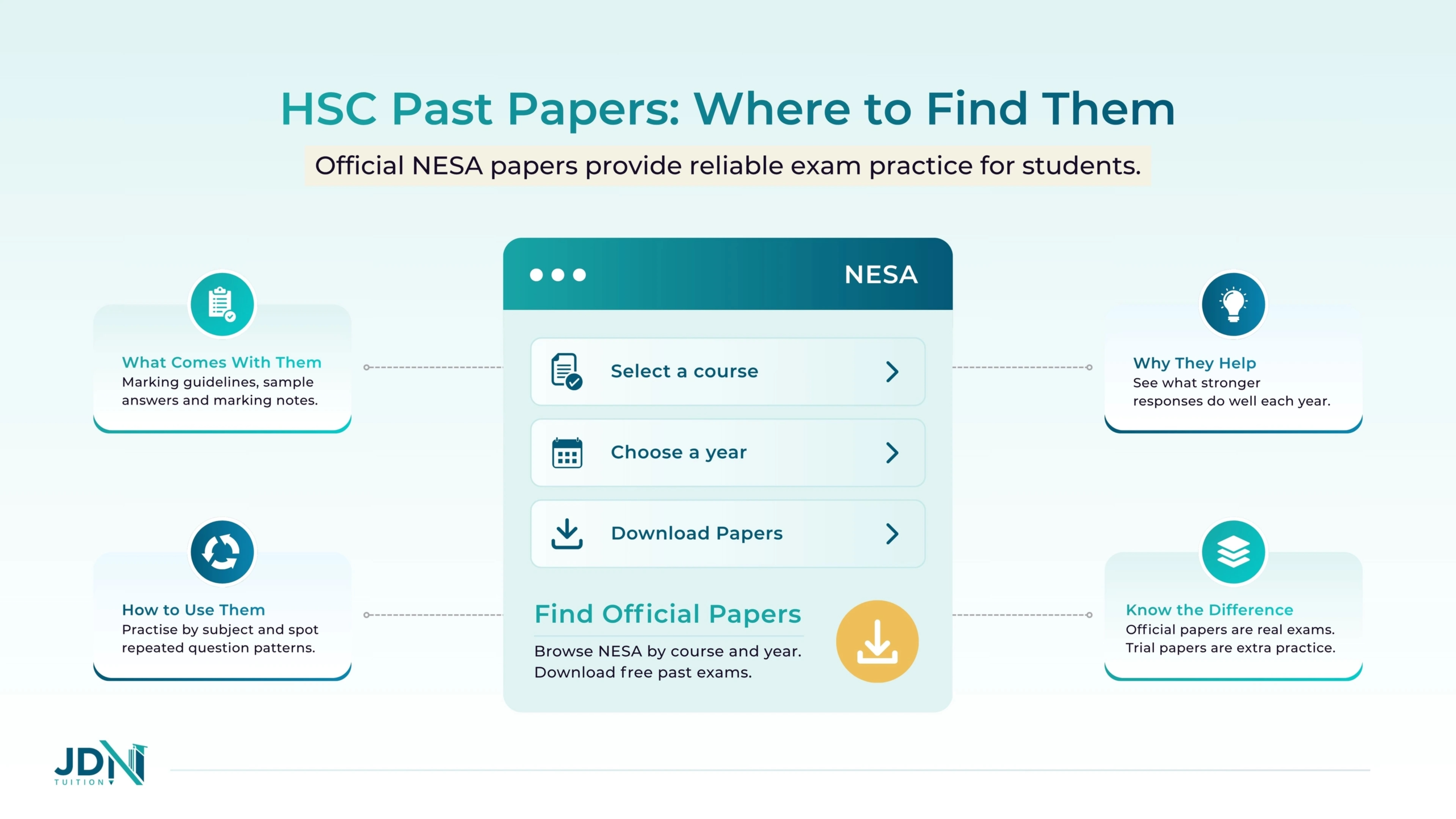
NESA lists the official NESA HSC past papers by course and year on their website.
Alongside each exam you will find the marking guidelines, sample answers where NESA provides them, and NESA’s marking feedback, which explains what stronger responses did well and where students commonly lost marks.
NESA keeps recent years online for each subject, so your child can work through several sittings of the same exam and spot the question types that come up again and again. NESA also publishes standards materials so students, teachers and markers all understand the standard set for each course.
Reading NESA’s marking feedback, once called the Notes from the Marking Centre, is a shortcut to what examiners reward. Each year they spell out the qualities of the stronger responses and the habits that cost students marks, which tells your child what to aim for before they even start.
It helps to know three kinds of paper. Past HSC exam papers from NESA are the real thing. HSC practice papers from other publishers, and your school’s HSC trials, are useful rehearsals, but other people wrote them and they do not carry the same authority.
Why Should You Start With the HSC Syllabus Before Past Papers?
Start with the HSC syllabus because it tells you exactly which outcomes and content each subject is examined on, so your child practises the right material from day one.
Every NESA course sets out the outcomes each exam is built to test. Once your child knows those outcomes, a past paper stops being a random set of questions and becomes a checklist of skills to master.
Syllabuses also change over time. A question from an older paper can sit outside the current course, so match each paper to the syllabus your child studies now and set aside anything that no longer applies.
Subject choice matters here too. The HSC subjects your child picks shape which papers deserve the most attention, especially where a course links to a university goal.
Line the papers up with the current HSC courses and your child’s NSW HSC preparation stays focused instead of scattered.
How Do You Build Past Papers Into an HSC Study Plan and Timetable?
Build past papers into a plan by starting around four to six weeks out and scheduling them around the exam timetable, rather than reaching for one at random the night before.
Begin while the notes are still fresh. In the early weeks your child can work through papers with notes beside them to learn the format, then move to independent timed practice as the exams draw closer.
Anchor the schedule to real dates. The 2026 HSC written exams start on Tuesday 13 October with English Paper 1 and finish on Thursday 5 November with Physics. Counting back from your child’s first exam shows how many papers realistically fit, and spreading them out keeps the final fortnight for polish rather than panic.
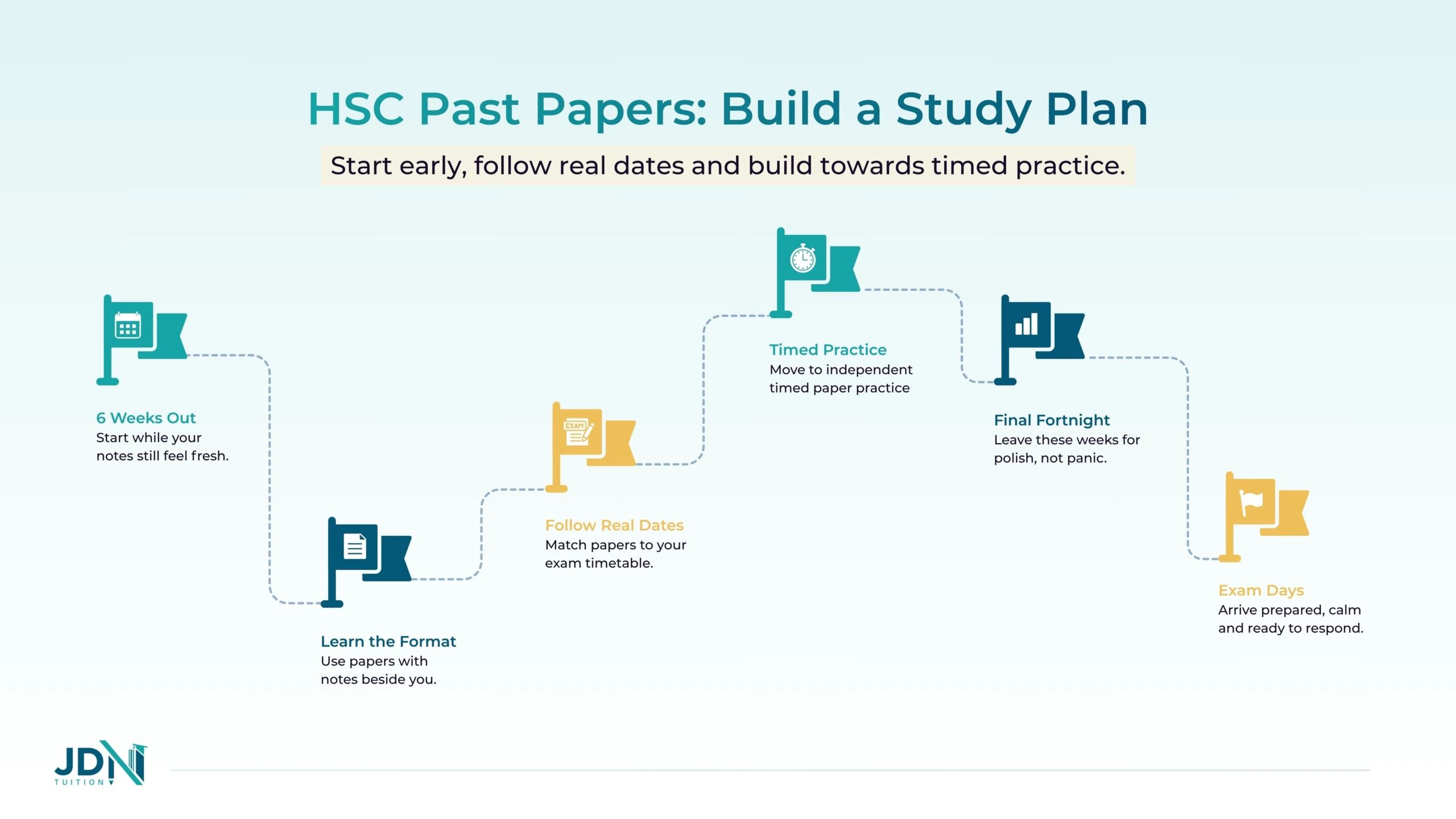
A shared HSC study plan keeps everyone honest about what gets done each week, and it turns the HSC exam timetable 2026 into a working calendar rather than a wall chart nobody reads.
The habit pays off early. Even in the junior years, learning how to study with HSC past papers makes senior HSC preparation far calmer than a last-minute scramble.
Worried your child is leaving their exam prep too late? JDN Tuition’s High School Tutoring for Juniors helps younger students build the past-paper habit early, and its Primary School Tutoring starts the groundwork sooner still, so the senior years feel far less daunting.
Why Should You Sit HSC Past Papers Under Timed Exam Conditions?
Sit past papers under timed exam conditions, with no notes and in a quiet room, because that is what builds the stamina and pacing your child needs on the day.
A paper done casually on the couch teaches the content but not the exam. Setting a timer, closing the notes and working in silence turns practice into a proper rehearsal.
Keep the setup the same each week, with the same desk, the same timer and the same quiet, and the real exam room starts to feel like just another practice run rather than a shock.
Timed practice does two jobs at once. It builds the stamina to write for hours, and it teaches pacing, so your child is far less likely to run out of time before the final question.
For pacing built around the HSC exams, the 80/20 rule and these time management tips give students a simple system to follow.
Treat the school HSC trials as full dress rehearsals, and by the time the real exams arrive the routine already feels familiar. A sticky note above the desk with the paper’s start and finish times keeps the conditions the same every week.
Is your child in Year 11 or 12 and still not sitting papers under real exam conditions? JDN Tuition’s High School Tutors for Seniors can shape that practice and mark each paper against NESA’s marking guidelines with your child. See how other families rate the results in our parent reviews and on our Google Business Profile. Call 0485 952 515 or book a free first call.
How Do You Mark Your Own Work Using NESA Marking Guidelines?
Mark your own work by checking every answer against NESA’s marking guidelines and sample answers to maximise mark gain.
A number tells your child nothing about why they lost marks. The marking guidelines show what each mark was awarded for, so a wrong or half answer becomes a clear lesson rather than a mystery.
Learn the language of the questions too. NESA’s glossary of key words explains directive verbs like analyse, evaluate, assess and discuss, and each one asks for a different kind of answer. Matching the response to the verb is often the gap between a Band 5 and a Band 6.
Keep an error log instead of a bare percentage. For each mistake, record the question, the type of error, why it happened, the fix and the date to retest it. Turn that log into a revision list, so the topics that show up most become the first thing your child practises the following week.
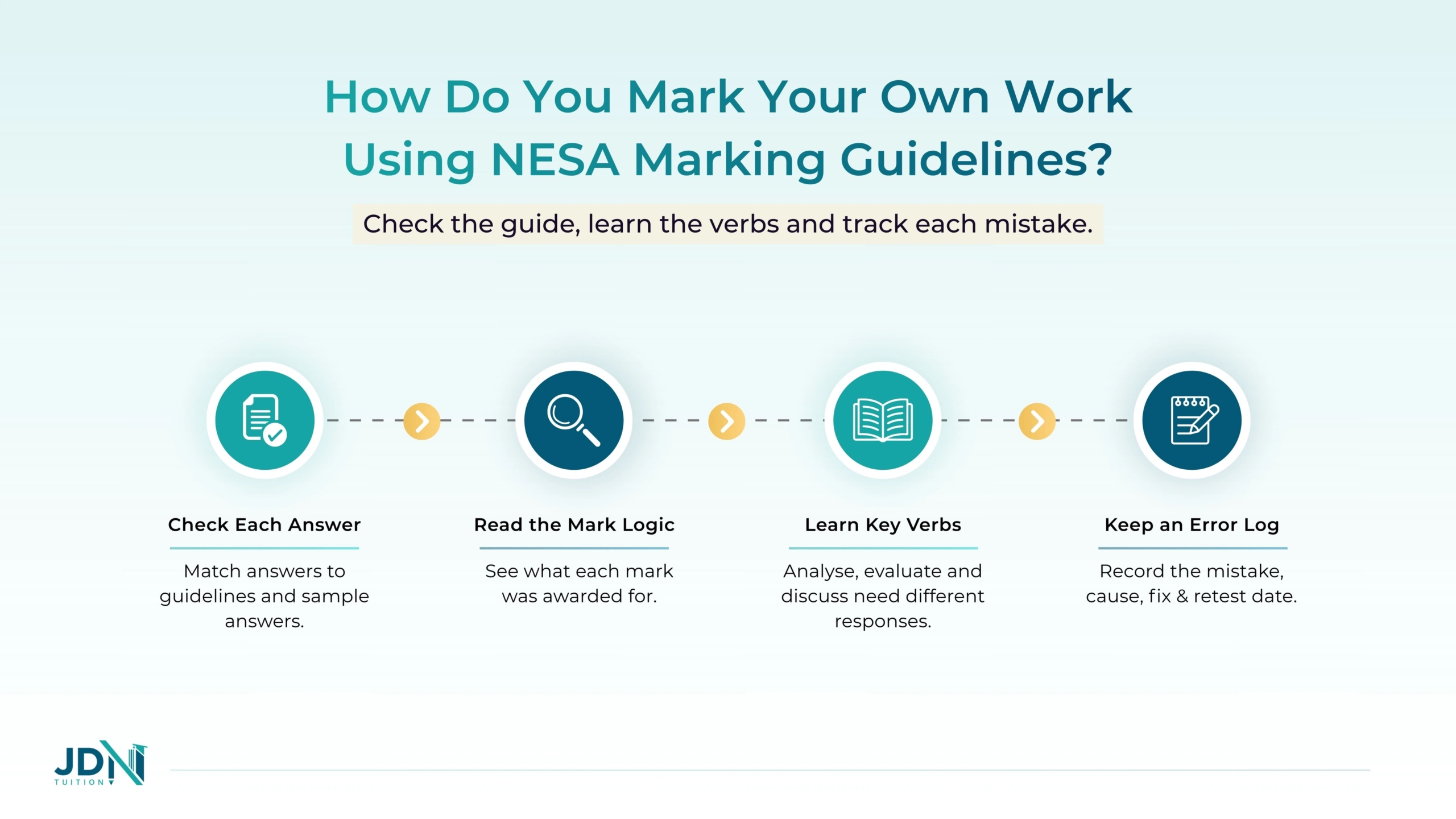
Honest self-marking is the best way to use HSC past papers, because every lost mark becomes something your child can fix before the next paper.
How Do Retrieval Practice and Spaced Repetition Turn Mistakes Into Marks?
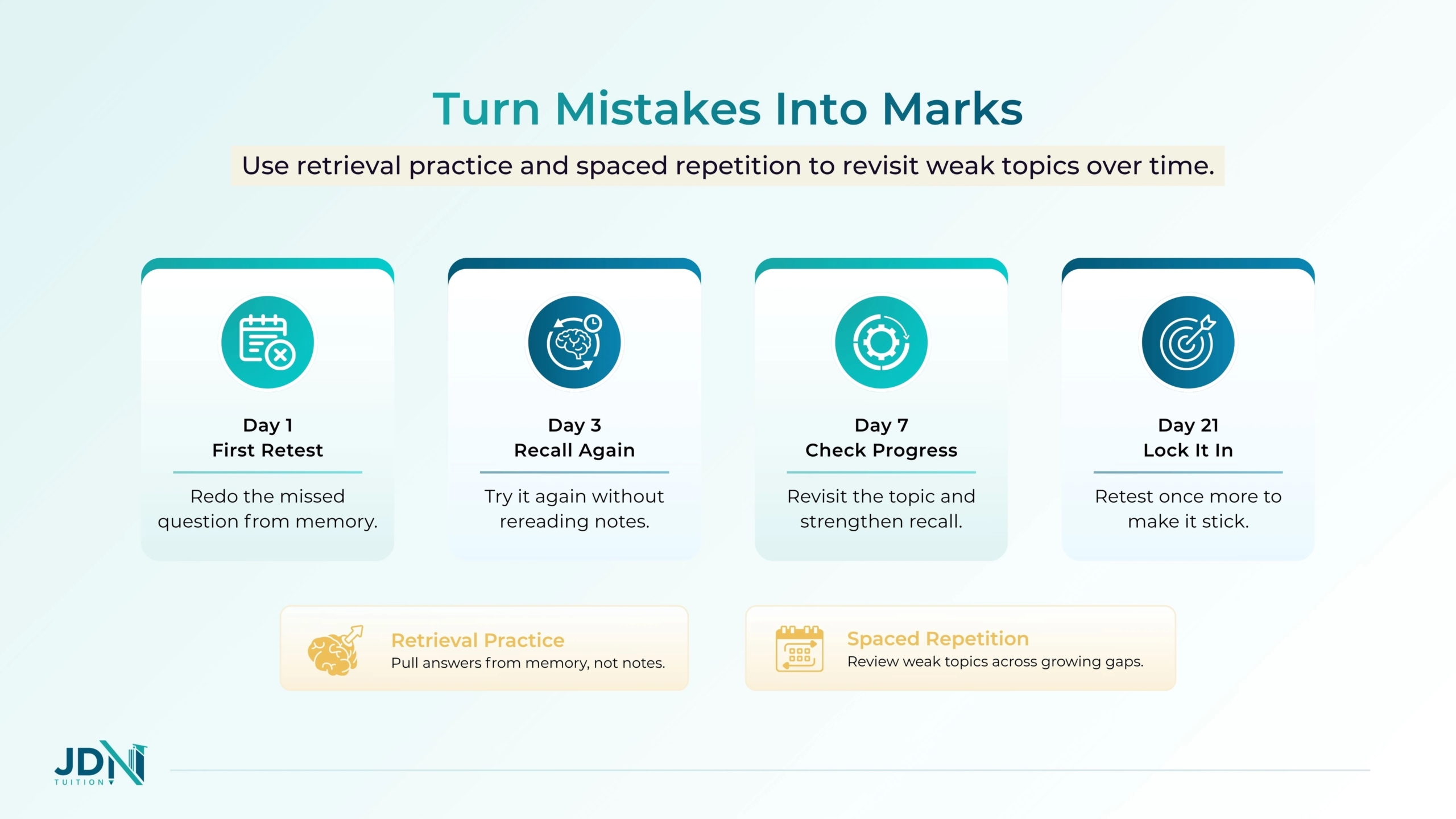
Retrieval practice and spaced repetition turn mistakes into marks by making your child recall weak topics from memory and revisit them over spaced intervals.
Retrieval practice means pulling an answer out of memory rather than rereading it. Research on the testing effect shows this beats rereading for long-term memory. Classroom studies have found it can even ease test anxiety, and testing old material carries a forward benefit that helps new topics stick faster.
Spacing is the second half. The spacing effect, first described by Ebbinghaus in 1885 and confirmed by later studies, shows that study spread over days sticks far better than a single cram session.
Put the two together on missed questions. When your child gets a question wrong, they redo it from memory a day later, then again after a few more days, folding the weak topic into a wider HSC exam revision plan.
A handful of effective revision techniques keeps each review shorter than the last, because the material your child already knows drops away and the weak spots stay in rotation.
Clean notes make this easier, so learn to take notes effectively and keep each session tight. These small habits are the backbone of strong HSC revision strategies.
How Should You Use Past Papers for English, Maths, Science and Business?
Use past papers differently by subject, because English and Business reward full essays, Maths rewards timed working, and the sciences reward well structured extended responses.
For essay subjects, half answers waste the practice. Encourage your child to write complete responses to HSC English past papers and HSC Business Studies past papers, then mark them against the criteria the way an examiner would. Business Studies essays in particular reward a clear structure and real case studies, which is where many students drop easy marks.
Maths is about showing working under pressure. Sitting HSC Maths past papers to the clock trains your child to set out each step clearly and to keep moving when a question stalls.
The sciences reward structure and diagrams. Working through HSC Biology past papers and HSC Chemistry past papers shows your child how to plan extended responses and label diagrams the way markers expect.
If writing is the sticking point, a specialist English tutor from JDN Tuition can work on essay technique with your child week by week.
How Does HSC Tutoring Help You Get More From Past Papers?
HSC tutoring helps because a tutor marks each paper against NESA’s marking guidelines and targets your child’s weak spots, which is exactly where self-study on past papers tends to fall short.
Marking your own work fairly is hard. A tutor reads each response against the marking guidelines, points out the missing marks and shows how to earn them next time, so every paper delivers more than a number.
Steady high school tutoring keeps the practice consistent too. A weekly session gives the past-paper routine a deadline, and it lets you back your child without becoming the marker yourself.
At JDN Tuition your child keeps the same tutor every lesson, hand-matched within 72 hours, and you get a note after every lesson and a written progress report after every 13 weeks of lessons, so you can see which past-paper mistakes are being fixed and which still need work.
That structure sits at the heart of how to prepare for HSC exams with less stress, whether your child learns in person or through online tutoring.
JDN Tuition offers HSC tutoring in Sydney, in your home or fully online, so families can pick the format that suits them best.

Why Should HSC Past Papers Be the Core of Your HSC Preparation?
HSC past papers should sit at the core of your child’s HSC preparation because, used well, they show exactly what the exam rewards and where marks are being lost.
The method is what matters. Start from the syllabus, build the papers into a plan, sit them under timed conditions, mark them honestly against NESA’s guidelines, then revise the gaps with retrieval practice and spacing.
Do that and each paper stops being busywork and starts moving your child toward their HSC ATAR goal, one exam block at a time. Strong HSC exam preparation is really just this loop, repeated with intent.
Ready to help your child get more from every past paper? Contact us at JDN Tuition, call 0485 952 515 or email contact@jdntuition.com.au.
Get More From Every Past Paper
Book a free call: 0485 952 515 | Email us: contact@jdntuition.com.au
Frequently Asked Questions
When should my child start using HSC past papers?
Around four to six weeks before each exam works well, starting with notes on hand and moving to timed practice as the day nears. Even the occasional paper in the junior years builds a habit that makes Year 12 far calmer.
Where can I download official NESA HSC past papers for free?
NESA publishes them free on the NSW Government website, listed by course and year, with the marking guidelines, sample answers and marking feedback for each exam. Start there rather than with third-party sets, because the official papers match the real standard and let your child mark honestly against what examiners reward.
How many HSC past papers should a student complete before the exam?
There is no fixed number, and quality beats quantity every time. Most students do well with a handful of papers per subject, sat under timed conditions, marked carefully against the guidelines and then revised with an error log. A few papers learnt from properly help far more than a dozen rushed and forgotten.
How can I help my child study for Year 12 exams?
Agree a weekly plan together, set up a quiet spot for timed papers, and talk through the marked results rather than the score. Keep the routine steady in the last six weeks, and if marking becomes a battle, a JDN Tuition tutor can take that role so you stay the supporter, not the examiner.